

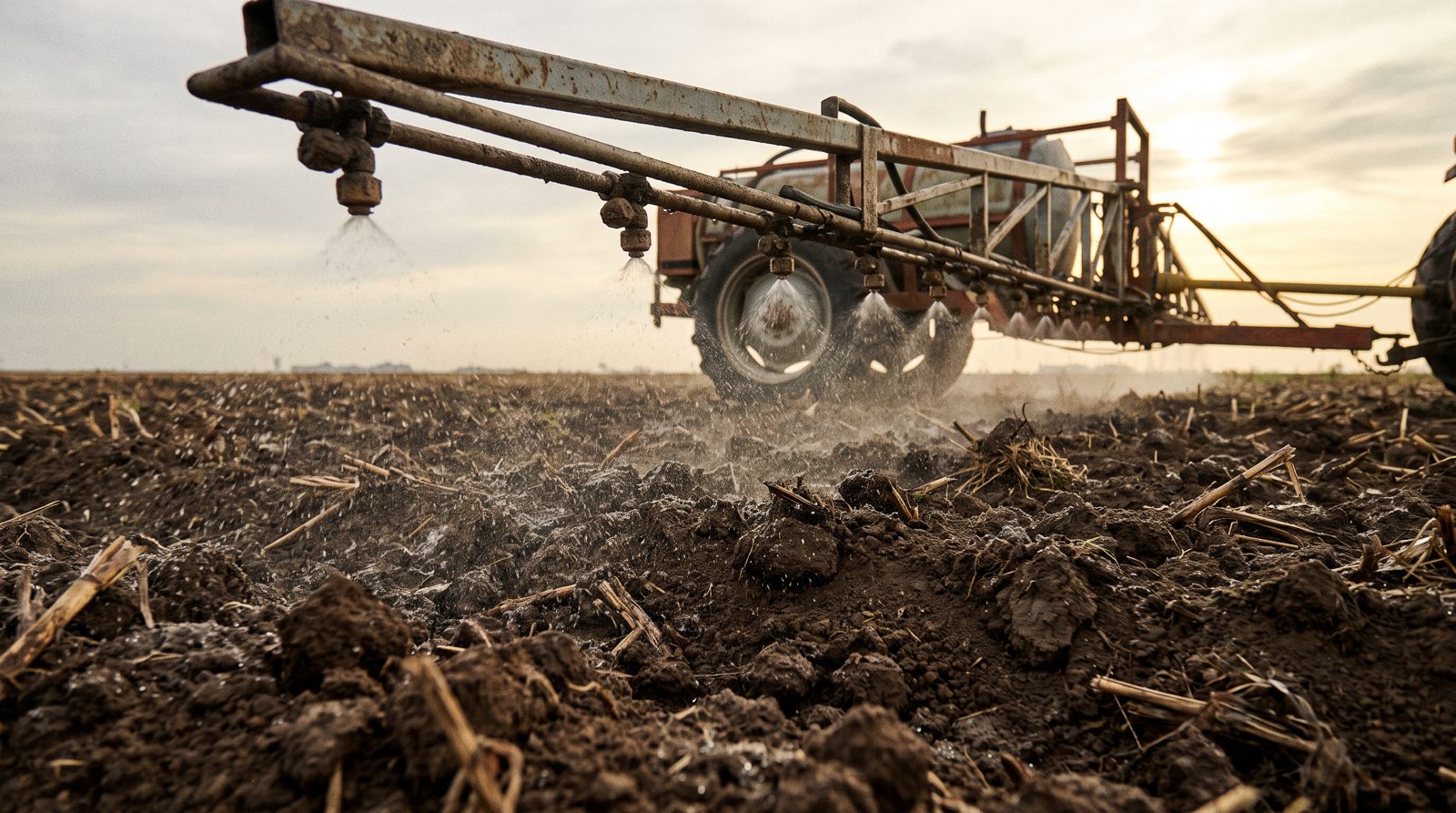
Liquid calcium fertilizer is calcium delivered in a soluble, usually chelated, form that you spray at gallons per acre instead of spreading tons of rock. On acidic ground it raises calcium base saturation and soil pH in weeks rather than the 18 to 36 months dry ag lime takes to fully react. It pays when a soil test shows low pH or low calcium, because that is when the rest of your fertilizer is being wasted.
Liquid calcium is not a tonic for every acre every year. It is a correction tool, and it earns its money on ground where acidity is holding back everything else you apply.
What is liquid calcium fertilizer?
It is a calcium source that is already dissolved and plant available when it hits the soil. The better products are chelated, meaning the calcium is bonded to an organic molecule that keeps it soluble and mobile until the soil and roots can use it.
That is the key difference from ag lime, which is ground rock that has to dissolve first, and from liquid lime, which is the same rock suspended in water. Chelated liquid calcium skips the wait.
AgriTec makes two: Pro-Cal, a bio-activated liquid calcium built for pH and calcium correction, and Advanced-Cal, the same correction plus chelated micronutrients and a microbial blend.
What does calcium actually do in the soil and the plant?
Calcium does two jobs, one in the soil and one in the crop.
In the soil, calcium is the main basic cation on the exchange sites. Your soil test reports base saturation: the share of those sites held by calcium, magnesium, potassium, and hydrogen. When hydrogen crowds out calcium, pH drops, nutrients get tied up, and fertilizer that is physically in the field cannot get into the plant. AgriTec’s rate model targets 75 percent calcium base saturation, with 65 to 75 percent as the maintenance range.
In the plant, calcium builds cell walls and drives cell division. Every new root tip and leaf depends on it. Because calcium moves poorly within the plant once it is placed, shortages show up in the newest growth and in fruit, which is where you see disorders like blossom end rot in tomatoes and bitter pit in apples.
Does liquid calcium fertilizer raise soil pH?
Chelated, bio-activated liquid calcium does. Adding calcium to the exchange sites pushes hydrogen off, and less hydrogen means higher pH. Balancing pH is really balancing those cations.
AgriTec has measured this. Across 13 paired independent-lab soil samples in the Pro-Cal and Advanced-Cal proof set (Nutrien/Waypoint, UGA, and on-farm samples), Pro-Cal moved soil pH an average of 0.78 units and Advanced-Cal 0.57 units. In AgriTec’s Arkansas cotton program, the pH correction was confirmed on the soil test inside the same season.
One caution: not every product sold as “liquid calcium” is built to move pH. Calcium nitrate and calcium chloride feed calcium but are not pH correctors. Read the label, and verify with a follow-up soil test rather than assuming.
How is liquid calcium different from lime and gypsum?
Lime and liquid calcium both raise pH; gypsum does not. The real split is speed and unit of measure.
| Dry ag lime | Gypsum | Chelated liquid calcium (Pro-Cal) | |
|---|---|---|---|
| What it is | Ground limestone | Calcium sulfate | Soluble, chelated calcium |
| Raises pH? | Yes, slowly | No, it is a neutral salt | Yes |
| Speed | 18 to 36 months to fully react | Supplies Ca and S in season | Typically begins reacting in 7 to 14 days |
| Unit of measure | Tons per acre | Hundreds of pounds per acre | 0.5 to 5.5 gallons per acre |
| Best fit | Long-term correction when time is not a constraint | Calcium and sulfur without a pH change | In-season pH and calcium correction |
Gypsum is a good product when pH is fine and you want calcium and sulfur; it will not fix low pH. Lime works, but on its own schedule, with tonnage to haul and spread. If you need the ground productive this season, that timeline is the constraint liquid calcium is built for. For the full program cost comparison, see Cost Benefits of Liquid Calcium vs. Lime.
When does liquid calcium fertilizer pay?
It pays when low pH is taxing the rest of your fertility program. That is where the return comes from, not from the calcium alone.
USDA Natural Resources Conservation Service data on nutrient availability by pH shows roughly 71 percent of applied fertilizer chemically unavailable at pH 4.5, 54 percent at pH 5.0, 33 percent at pH 5.5, 20 percent at pH 6.0, and essentially none at pH 6.5. University of Arkansas Extension cotton fertility data puts it another way: below pH 5.5, roughly 30 to 50 percent of applied nitrogen and phosphate is tied up. If you are spending on fertility across ground at pH 5.5, a third of that spend may not be reaching the crop.
On the yield side, AgriTec’s ROI modeling uses the Li et al. 2019 global liming meta-analysis, which puts the response to correcting low pH at about 12 percent for corn and 18 percent for soybeans. Auburn University work (Rogers 1973, 52 tests over 7 years) measured soybean gains of 5 to 27 bushels per acre from liming soils at pH 4.8 to 5.5.
Read all of those as planning assumptions for pH-limited acres, not promises. On ground already at pH 6.5 with good base saturation, the honest answer is that you do not need a correction, and AgriTec’s rate model returns zero gallons in that case.
Is there trial data on liquid calcium itself?
Yes. In a 2024 University of Florida IFAS trial at the West Florida Research and Education Center in Jay, Florida (Dr. Hardeep Singh, Study 113-24), one pass of Advanced-Cal at 3 gallons per acre at early pegging produced 6,300 lb/ac of runner peanuts. A full 1,250 lb/ac gypsum program made 5,676 lb/ac, and the untreated check made 5,435 lb/ac. Grade held, with TSMK at 73.7 percent for both Advanced-Cal and gypsum against 72.3 percent untreated.
Read it with its limits. It is one year at one site in small replicated plots, and the report carries no p-value, LSD, or CV, so those are measured plot means rather than statistically separated treatments. Rate response was not a straight line either: 4 gallons per acre returned almost nothing while 3 and 5 gallons both gained. That is the argument for sizing the rate off a soil test. The full write-up is in the UF peanut trial report.
How much liquid calcium fertilizer do I apply per acre?
Start with a soil test, because the rate depends on two numbers: current pH and current calcium base saturation. As a starting reference, AgriTec’s rate guide for Pro-Cal reads:
| Soil pH | Ca base saturation | Pro-Cal rate |
|---|---|---|
| 6.5 to 7.0 | 65 to 75% | 0.5 gal/ac (maintenance) |
| 6.0 to 6.4 | 59 to 64% | 2.0 gal/ac |
| 5.5 to 5.9 | 50 to 60% | 3.0 to 3.5 gal/ac |
| 5.0 to 5.4 | 40 to 50% | 3.5 to 4.5 gal/ac |
| 4.5 to 4.9 | 30 to 40% | 5.5 gal/ac |
An agronomist then tunes that to your CEC. Heavier, high-CEC soils hold more exchange sites, so each gallon moves base saturation less and the rate goes up. Broadcast applications carry a 3 to 4 year residual; in-row programs run 1 to 2 gallons annually, with a 2.0 gallon ceiling.
More is not better. Overapplying calcium wastes money and can stress the crop, which is one of the points covered in Common Misconceptions About Liquid Calcium.
How do I apply it, and what can I mix it with?
Liquid calcium goes through equipment you already own: a boom sprayer for broadcast, in-row at planting, drip where you have it, and foliar for in-season calcium on fruiting crops. Placement is more even than a dry spread, with no streaks left uncorrected.
One compatibility rule matters before you fill a tank: do not mix Pro-Cal with sulfur products such as ATS, or with phosphate blends such as 3-18-18+. Run calcium passes separately, and jar test anything new before you scale up.
On pasture and hay ground, correcting pH also shifts the competition. Acid-loving weeds like broomsedge thrive at low pH; bring the soil back into range and the desirable grass comes back strong enough to choke them out. More on that in our broomsedge guide.
Pro-Cal or Advanced-Cal: which one fits my field?
Let the soil test decide.
Pro-Cal is the pH and calcium-correction workhorse. If the test shows low pH and low calcium base saturation and the rest of the report looks reasonable, start here.
Advanced-Cal delivers the same calcium correction plus chelated micronutrients (boron, manganese, iron, sulfur) and a microbial blend in one pass. It fits long-cropped ground where the test shows micronutrient or biology deficits on top of the calcium gap.
If you want a second set of eyes on the numbers, send us a soil sample. AgriTec’s soil test review and agronomy consult are free to anyone who asks, customer or not.
Frequently asked questions
What is liquid calcium fertilizer?
Liquid calcium fertilizer is calcium delivered in a soluble form, usually chelated, that goes on through a sprayer at gallons per acre. Because the calcium is already available when it lands, it raises calcium base saturation and soil pH in weeks instead of waiting on limestone to dissolve. AgriTec’s Pro-Cal and Advanced-Cal are chelated liquid calcium products.
Does liquid calcium fertilizer raise soil pH?
Chelated, bio-activated liquid calcium like Pro-Cal does. It adds calcium to the soil’s exchange sites, which pushes hydrogen off and raises pH. Across 13 paired independent-lab soil samples in AgriTec’s proof set, Pro-Cal moved pH an average of 0.78 units and Advanced-Cal 0.57 units. Not every liquid calcium product is built to do this, so check what you are buying.
How much can liquid calcium increase yield?
Yield response depends on how far off your pH is, plus soil, weather, and management. For ROI planning, AgriTec uses the Li et al. 2019 global liming meta-analysis, which puts the response to correcting low pH at about 12 percent for corn and 18 percent for soybeans. Treat those as planning assumptions for pH-limited acres, not promises, and verify with a follow-up soil test.
Does liquid calcium make other fertilizers work better?
On acidic ground, yes. USDA NRCS nutrient availability data shows roughly 71 percent of applied fertilizer chemically unavailable at pH 4.5, 33 percent at pH 5.5, and essentially none locked out at pH 6.5. Correcting pH puts more of the fertilizer you already bought to work.
How is liquid calcium different from gypsum?
Gypsum supplies calcium and sulfur but does not neutralize soil acidity, because calcium sulfate is a neutral salt. Liquid calcium products like Pro-Cal supply calcium and also raise pH. Use gypsum when you want calcium and sulfur without changing pH; use liquid calcium when you also need pH correction.
How much liquid calcium fertilizer do I need per acre?
It is sized off your soil test. As a starting reference from AgriTec’s rate guide, ground at pH 6.0 to 6.4 runs about 2 gallons of Pro-Cal per acre, pH 5.5 to 5.9 runs 3 to 3.5 gallons, pH 5.0 to 5.4 runs 3.5 to 4.5 gallons, and pH 4.5 to 4.9 runs 5.5 gallons. An agronomist then tunes the rate to your CEC and calcium base saturation.
Related reading
- What Is Liquid Lime, and Does It Work Like Ag Lime?, for why liquid lime and liquid calcium are not the same thing.
- Common Misconceptions About Liquid Calcium, on rates, timing, and tank mixing.
- How to Raise Soil pH Without Lime, for correction programs worked through mild to severely acidic ground.