

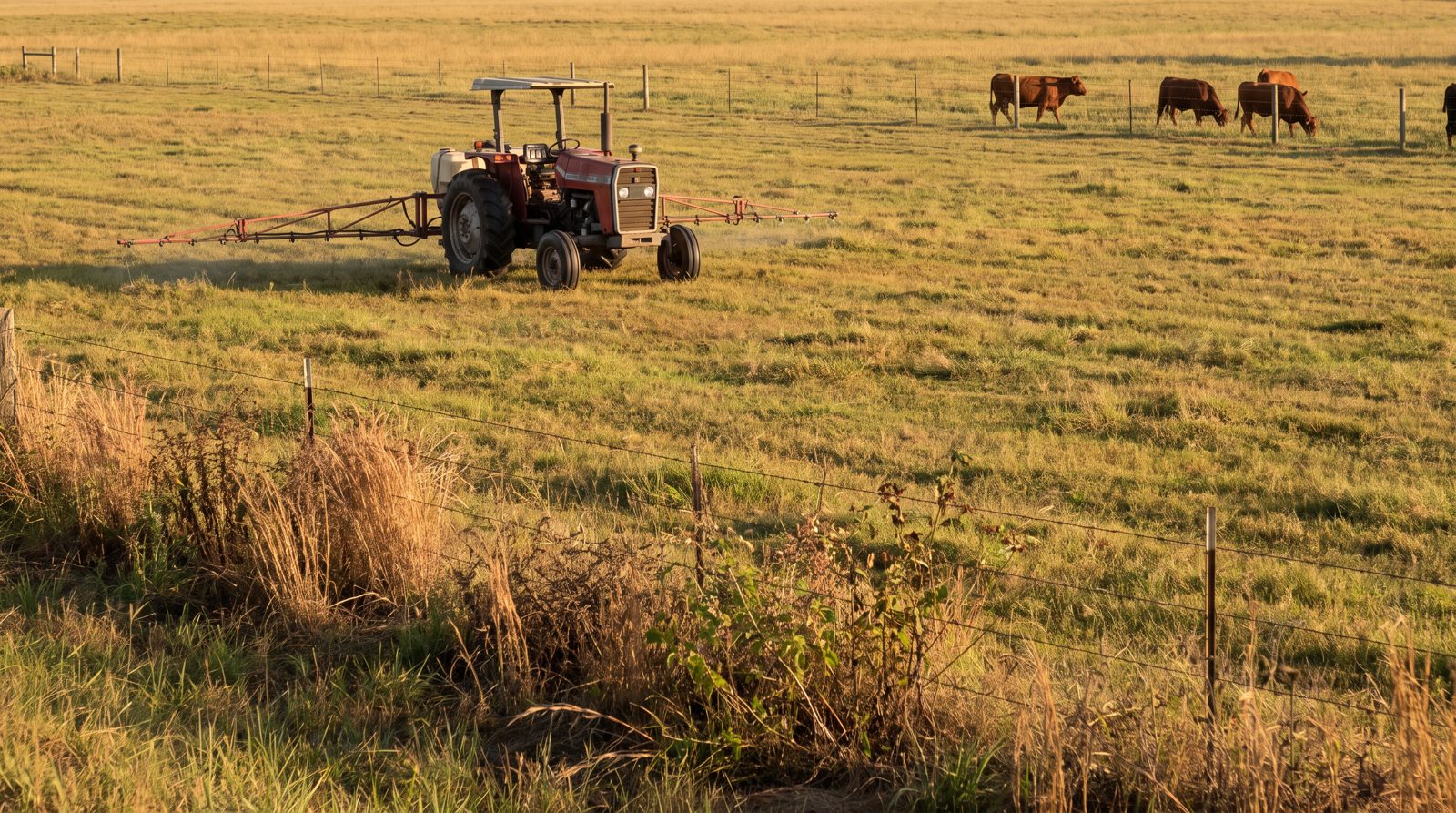
Yes, you can use liquid lime on pasture, and it spreads more evenly than dry lime, but it is still ground limestone suspended in water. The limestone has to dissolve before pH moves, so liquid lime corrects a pasture on the same slow timeline as the dry lime it is made from. If you need pH and calcium moving this season, chelated liquid calcium such as AgriTec’s Pro-Cal is the faster tool, applied at gallons per acre off a soil test.
On pasture, that difference decides whether you see a change this season or two seasons from now.
Can you use liquid lime on pasture?
Yes, and it has real advantages on grass. Liquid lime goes through a sprayer instead of a spreader truck, which matters on rolling or wet pasture ground, and the application is more uniform than a dry spread pattern, so you get less streaking.
What it does not change is the chemistry. Mississippi State University Extension describes a typical liquid lime as roughly 50 percent high quality dry ag lime with a relative neutralizing value above 90 percent, carried in about 50 percent water (Lemus and Johnson, Forage News, Mississippi State University Extension, May 2019). The active ingredient is limestone, and limestone works by dissolving in soil moisture and acid. Fine grinding helps it dissolve faster than coarse lime, but it is still a limestone timeline.
Pasture adds one more wrinkle. You cannot disk lime into an established sod, so anything surface applied, liquid or dry, stays in the top few inches of soil for years while it works down. We cover the full chemistry in What Is Liquid Lime, and Does It Work Like Ag Lime?.
What is the difference between liquid lime and liquid calcium?
Liquid lime is a suspension of rock. Chelated liquid calcium is a solution, with the calcium already in a form the soil and the plant can use when it lands.
Pro-Cal is AgriTec’s bio-activated liquid calcium: it delivers the soluble calcium portion of lime in a fast-acting form, raises pH, and balances calcium base saturation. Advanced-Cal is the same correction plus chelated micronutrients (boron, manganese, iron, sulfur) and a microbial blend, built for ground whose soil test shows more than one deficit.
| Liquid lime | Chelated liquid calcium (Pro-Cal) | |
|---|---|---|
| What it is | Ground limestone suspended in water | Calcium in a soil-available, chelated form |
| Speed to pH movement | Months; the limestone must dissolve first | Typically begins reacting in 7 to 14 days |
| Unit of measure | Tons of limestone per acre | 0.5 to 5.5 gallons per acre, off the soil test |
| Logistics | About half of every tank is water | Standard sprayer passes |
| Best fit on pasture | Maintenance top-up near target pH | Correcting acidic, calcium-short sod this season |
How fast does liquid lime work on pasture?
Slowly, because it is limestone. Dry ag lime takes 18 to 36 months to fully react, and surface-applied lime on untilled pasture needs roughly 6 to 12 months just to start breaking down. Liquid lime’s fine grind gives it a head start, but plan in months, not weeks.
Chelated liquid calcium works on a different clock. Pro-Cal typically begins reacting within 7 to 14 days and moves the soil test in weeks. In AgriTec’s Arkansas cotton program, pH correction was confirmed on the soil test inside the same season.
Why the months matter: USDA Natural Resources Conservation Service data on nutrient availability by pH shows roughly 71 percent of applied fertilizer chemically unavailable at pH 4.5, 54 percent at pH 5.0, 33 percent at pH 5.5, 20 percent at pH 6.0, and none locked out at pH 6.5. If you are buying nitrogen for a hay field at pH 5.5, treat roughly a third of that spend as not reaching the grass until the correction happens. That is a planning assumption for your own budget, not a guaranteed return.
How much liquid lime or liquid calcium does a pasture need per acre?
Liquid lime has to match a lime recommendation written in tons of limestone, and half of every tank is water. Matching a 1 to 2 ton per acre recommendation means moving a large volume of liquid across the pasture, which is why liquid lime works best as a top-up on ground already close to target.
Liquid calcium is written in gallons. Pro-Cal runs 0.5 to 5.5 gallons per acre depending on your soil pH and calcium base saturation. AgriTec’s hay and pasture program starts with Pro-Cal at 3 to 5 gallons per acre as the foundation pass on acidic ground, and broomsedge pastures, which typically test pH 4.8 to 5.5, usually land in that range. The exact number comes off your soil test, because pH alone does not tell the whole story: heavier soils with a higher CEC take more product to move the same distance.
When should you apply liquid lime or liquid calcium to pasture?
Fall. Put it out any time after your last cutting or after you pull cattle off for the season, and before the ground freezes.
Liquid lime needs every month it can get before spring. With liquid calcium the window is wider: because Pro-Cal begins reacting within 7 to 14 days, even a late-fall pass has pH moving before spring green-up. One North Carolina grower, Casey A., put out 4 gallons per acre of Pro-Cal with a half gallon of Gro in December 2017 and nothing else. His photo from June 12, 2018 shows the same pasture green and clear of broom sage, with no fertilizer applied. That is one grower’s result, not a promise, but it is the fall timeline in practice.
Re-test the soil 9 to 12 months after application so you can see the movement on paper and plan the next pass from data.
Can cattle graze after a liquid calcium application?
Yes, once the spray has dried. Standard practice in AgriTec’s pasture programs is to let the spray dry before grazing and to follow all product label directions.
Two tank-mix rules matter on pasture, where herbicides often ride along in the same pass. Per AgriTec’s mixing compatibility guide, never tank-mix Pro-Cal or Advanced-Cal with 2,4-D, Grazon, RoundUp, high-sulfur or high-phosphorus products, or potash. Keep those in a separate pass. Pro-Cal does mix with a number of pasture herbicides, including Pasture Guard, DuraCor, Remedy and MSM, but jar test every combination before it goes in the tank.
Does liquid calcium cost less than liming a pasture?
Often, but run it on your own numbers. The cleanest comparison on file comes from AgriTec’s Nebraska wheat lime-replacement program, where Pro-Cal at 4 gallons per acre replaced 1.5 to 2 tons of dry lime and saved roughly $72 per acre while correcting in-season.
That is a wheat program, not a pasture trial, and lime prices and freight vary a lot by region. Treat the $72 as a planning assumption. On pasture, the bigger cost question is often timing: every season the correction is not happening is a season of fertilizer working at the NRCS discount above.
Does fixing pH on a pasture actually grow more grass?
When low pH and calcium are what is holding the stand back, growers see it. The evidence on file for pasture is grower-reported rather than replicated, so read it that way.
- Soil test movement. A Texas Bermuda hay field in AgriTec’s soil test library went from pH 5.2 to 6.5 after Pro-Cal, on the grower’s own before and after lab reports.
- Tonnage and weeds. Kenneth, a North Carolina hay grower, reported around 20 percent more hay on each field that got Pro-Cal in 2024, and no broomsedge in spring cutting.
- A full program, not calcium alone. A hybrid Bermuda producer in Whitesboro, Texas weighed a 2026 first cutting at 3.19 tons per acre against his 25-year average of 2.0, a 59 percent gain (Whitesboro Producer 2026 Testimonial Booklet). That field got Advanced-Cal at 4 gallons per acre plus 3-18-18+ and Nitro-Maxx+, so credit the program, and remember it is one producer and one season.
Broomsedge is worth a word on its own. It is an indicator plant that moves in on acidic, calcium-poor ground where bermudagrass and fescue cannot compete. Correct the pH and calcium, and the recovering stand chokes it out, usually over one to three seasons as the grass thickens. There is more on that in our broomsedge guide.
What is the best liquid lime for pastures?
If you want a liquid you can spray that moves pH and calcium this season, the best choice is not liquid lime at all. It is a chelated liquid calcium.
Use Pro-Cal when the soil test shows low pH and low calcium base saturation and not much else. Use Advanced-Cal when the test also shows micronutrient shortfalls, or the pasture has been cut or grazed hard for years. Liquid lime still has a place on ground sitting just under target that needs a maintenance top-up, where speed does not matter and the tonnage is small.
Either way, start with a soil test. The decision hinges on two numbers no label can give you: your current pH and your calcium base saturation. Send us a soil sample and an AgriTec agronomist will read every number and write the rate for each field. The soil test review and agronomy consult are free to anyone who asks, whether or not you ever buy a jug from us.
Frequently asked questions
Does liquid lime work on pasture?
Yes. Liquid lime is finely ground limestone suspended in water, so it neutralizes acidity the same way dry lime does and spreads more evenly with a sprayer. It does not skip the step where limestone has to dissolve, so it corrects pasture pH over months, not weeks, and on untilled sod it stays near the surface.
What is the best liquid lime for pastures?
If the goal is a liquid you can spray that moves pH and calcium this season, look past liquid lime to chelated liquid calcium. AgriTec’s Pro-Cal is the straight pH and calcium correction; Advanced-Cal adds chelated micronutrients and a microbial blend. Either one is sized in gallons per acre off your soil test.
How much liquid calcium does a pasture need per acre?
Pro-Cal runs 0.5 to 5.5 gallons per acre depending on soil pH and calcium base saturation. AgriTec’s hay and pasture program starts at 3 to 5 gallons per acre on acidic ground, and broomsedge ground testing pH 4.8 to 5.5 typically runs in that range. The exact rate comes off your soil test.
When should I apply liquid calcium to pasture?
Fall is the best window: any time after the last cutting and before the ground freezes. Pro-Cal typically begins reacting within 7 to 14 days, so a fall pass has pH moving well before spring green-up. Re-test the soil 9 to 12 months later to confirm the correction.
Can cattle graze after a liquid calcium application?
Standard practice in AgriTec’s pasture programs is to let the spray dry before turning cattle back in, and to follow all product label directions. There is no separate grazing restriction beyond the label.
How long does liquid calcium last on pasture?
A broadcast application of Pro-Cal typically carries a 3 to 4 year residual, the same maintenance cycle growers run with high quality lime. Plan the next pass off a follow-up soil test rather than the calendar.