
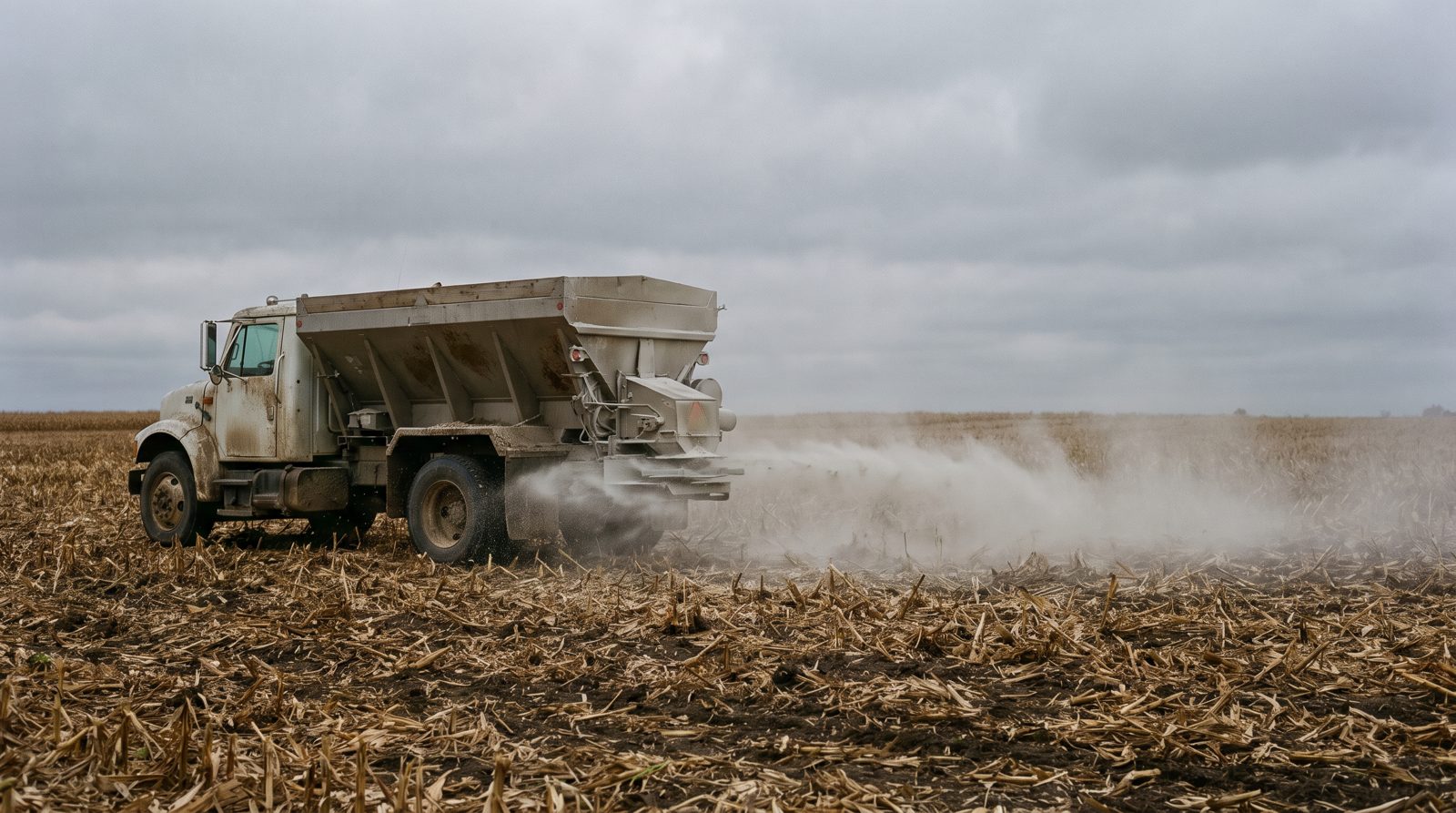
Liquid lime is finely ground agricultural limestone suspended in water, typically about half limestone and half water. It is a different way to haul and spread lime, not a different way to correct soil pH: the limestone still has to dissolve in the soil before pH moves, so it works on the same slow timeline as the dry ag lime it is made from.
That distinction matters, because “liquid lime” and “liquid calcium” often get used as if they mean the same thing, and they do not. Here is what liquid lime actually is, where it fits, and how to tell which one your field needs.
The short version up front: if you are looking at liquid lime because dry lime is too slow, the category actually built for speed is chelated liquid calcium. That is what AgriTec’s Pro-Cal and Advanced-Cal are, and the difference between the two categories is most of this article.
What is liquid lime made of?
Liquid lime is a suspension, which means solid particles held in a liquid rather than dissolved in it. Mississippi State University Extension put a number on the typical formulation: roughly 50 percent high quality dry ag lime with a relative neutralizing value above 90 percent, carried in about 50 percent water (Lemus and Johnson, Forage News, Mississippi State University Extension, May 2019).
So the active ingredient is limestone. The water is a carrier that lets you run the material through a sprayer instead of a spreader truck, and lets you place it more evenly than a dry spread pattern.
Does liquid lime work like ag lime?
Chemically, yes, and that is the part worth understanding. Limestone neutralizes soil acidity by dissolving and releasing carbonate, and that reaction depends on the limestone contacting soil moisture and acid. Suspending the limestone in water first does not skip that step.
Two things do genuinely help. The limestone in a liquid suspension is ground very fine, and finer particles dissolve faster than coarse ones. And the application is more uniform than a dry spread, so you get less of the streaking that leaves parts of a field uncorrected. Those are real advantages of the format.
What the format does not change is the timeline. If your ground needs pH movement before you plant, liquid lime is still limestone waiting to dissolve.
What is the catch on rate?
The tonnage math. A lime recommendation is written in tons of limestone per acre, and a liquid lime suspension is about half water by weight. A tank of liquid lime therefore carries roughly half the limestone of the same weight of dry product, before you account for the difference between sprayer capacity and a spreader truck.
On a field sitting close to target that needs a light top-up, that is manageable. On a field at pH 5.2 that needs a full correction, matching the recommendation in liquid form means a lot of loads. That is why liquid lime tends to show up as a maintenance tool rather than a rescue tool.
How much is low pH actually costing?
Enough to make the timeline question worth taking seriously. USDA Natural Resources Conservation Service data on nutrient availability by pH shows roughly 71 percent of applied fertilizer chemically unavailable to the crop at pH 4.5, 54 percent at pH 5.0, 33 percent at pH 5.5, 20 percent at pH 6.0, and none of it locked out at pH 6.5.
Read that as a fertilizer efficiency problem rather than a yield promise. If you are buying fertilizer for ground sitting at pH 5.5, roughly a third of that spend is not reaching the crop, and it stays that way for every month the correction has not happened yet. Any per acre figure you work off that is a planning assumption for your own budget, not a guaranteed return.
What is liquid calcium, and how is it different?
Liquid calcium is a chelated calcium solution rather than a suspension of ground rock. The calcium is already in a form the soil and plant can use when it lands, so it is not waiting on a dissolution step.
Pro-Cal is AgriTec’s bio-activated liquid calcium: it delivers the soluble calcium portion of lime in a fast-acting form, raises pH, and balances calcium base saturation, typically beginning to react within 7 to 14 days and moving the soil test in weeks instead of the 18 to 36 months dry ag lime takes to fully react. In AgriTec’s Arkansas cotton program, pH correction was confirmed on the soil test inside the same season. The stakes are concrete: at pH below 5.5, roughly 30 to 50 percent of applied nitrogen and phosphate is tied up (University of Arkansas Extension cotton fertility data), so every month a correction has not happened is a month of fertilizer spend working at a discount.
Advanced-Cal is the same chelated calcium correction with chelated micronutrients and a microbial blend in the same pass, built for fields whose soil test shows more than one deficit.
The practical difference is the unit of measure. Lime programs are written in tons per acre. AgriTec’s calcium program is written in gallons per acre, sized off your soil test rather than a blanket rate. As a rough reference from AgriTec’s rate guide: ground at pH 6.0 to 6.4 with 59 to 64 percent calcium base saturation is a 2 gallon per acre job, pH 5.5 to 5.9 with 50 to 60 percent runs 3 to 3.5 gallons, pH 5.0 to 5.4 runs 3.5 to 4.5 gallons, and pH 4.5 to 4.9 runs 5.5 gallons. Broadcast applications carry a 3 to 4 year residual; in-row runs 1 to 2 gallons annually, with a 2.0 gallon ceiling.
One compatibility rule is worth knowing before you plan a tank: do not mix Pro-Cal with sulfur products such as ATS, or with phosphate blends such as 3-18-18+. Run calcium passes separately, and jar test anything new before you scale up.
Liquid lime vs chelated liquid calcium at a glance
| Liquid lime | Chelated liquid calcium (Pro-Cal) | |
|---|---|---|
| What it is | Finely ground limestone suspended in water | Calcium already in a soil-available, chelated form |
| Speed to pH movement | Months; the limestone must dissolve first | Typically begins reacting in 7 to 14 days |
| Unit of measure | Tons per acre | 0.5 to 5.5 gallons per acre, sized off the soil test |
| Logistics | High volume; about half of every tank is water | Standard sprayer passes |
| Best fit | Maintenance top-up on ground already near target | In-season pH and calcium correction |
Is there trial data behind the liquid calcium side?
There is, and it is worth reading with its limits in view. In a 2024 University of Florida IFAS trial at the West Florida Research and Education Center in Jay, Florida (Dr. Hardeep Singh, Study 113-24), Advanced-Cal at 3 gallons per acre produced 6,300 lb/ac of runner peanuts, against 5,676 lb/ac from a full 1,250 lb/ac gypsum program and 5,435 lb/ac from the untreated check. Grade held, with TSMK at 73.7 percent on both the Advanced-Cal and the gypsum treatments against 72.3 percent untreated.
The caveats come straight from the report: one year at one site in small replicated plots, with no p-value, LSD or CV, so those are measured plot means rather than statistically separated treatment means. The report itself notes that yield differences of that size can sit within normal field to field variability. Rate response was not a straight line either, since 4 gallons per acre returned almost nothing while 3 and 5 gallons both gained. That is the argument for sizing a rate off a soil test rather than a blanket number.
What the trial does support cleanly is the format argument: three gallons of a liquid calcium did the work of well over half a ton of a dry calcium material, in the same field, in the same season. Treat the yield figures as a planning assumption, and read the full report rather than the summary.
How do I decide which one my field needs?
Start with a soil test, because the decision hinges on two numbers no product label can tell you: your current pH and your current calcium base saturation. The gap between where those sit and where they need to be sets the rate, and it also tells you whether you have a top-up situation or a correction situation.
Then ask how much time you have. If the correction can happen over a season or two of maintenance, a lime program in whichever format suits your equipment is a reasonable answer. If you need the ground productive this season, the dissolution timeline is the constraint, and that is the case liquid calcium is built for.
On acidic ground that needs correction now, our recommendation is straightforward: Pro-Cal sized off your soil test, or Advanced-Cal when the test also shows micronutrient or biology deficits alongside the calcium gap.
If you want help reading the test, send us a soil sample. AgriTec’s soil test review and agronomy consult are free to anyone who asks, whether or not you ever buy a jug from us.
Related reading
- Cost Benefits of Liquid Calcium vs. Lime, for the program cost comparison over a full residual period.
- How to Raise Soil pH Without Lime, for the rate guide worked through mild, moderate and severely acidic ground.
- Can You Use Liquid Lime on Pasture?, for pasture rates, timing and what to expect on grazed or cut ground.
- Hay and pasture programs, if the ground in question is grazed or cut.