

 View full report →
Hay & Pasture · Weed pressure
Broomsedge is a symptom, not the problem.
Sage grass shows up where pH has dropped and calcium is gone, ground your forage can't compete on. Correct the soil and the grass comes back thick enough to choke it out. No extra pass. Growers in 11 states have watched it happen.
Size it to your acres
How much Advanced-Cal do you need?
Recommended rate: – gal/ac to reach 75% Ca base saturation
Enter your CEC and current Ca base saturation from your soil test, and we calculate the gal/ac to hit the 75% target, then size the order. Your agronomist confirms against your full test.
Enter your numbers and we'll pack the exact containers: delivered total, freight included. No surprises at the dock.
Your Ca base saturation is already at or above 75%.
You don't need a calcium application right now. Save it for the fields that do. Ask an agronomist what your soil actually calls for.
You'll need
–
We'd ship you
Delivered total
–
freight included · – / ac
–
Running tanker-scale volume? Bulk tanker loads are call-to-order: (833) 247-4832.
Pay in 4* 4 interest-free payments of – with PayPal Pay Later. Just – due today. John Deere Financial and AgQuest also available.
*Financing at checkout, subject to approval. Terms apply.
Your sized package
–
Pay in 4* Split it into 4 interest-free payments with PayPal · John Deere Financial · AgQuest · *terms apply
Paid securely at checkout: card or PayPal, including Pay in 4. Shipping is free on most orders, and a free soil or tissue kit comes with orders above $300. An AgriTec agronomist confirms quantities and delivery before anything ships. If anything needs adjusting, we refund the difference first. Prefer financing? Call (833) 247-4832.
Before & after · same pasture
December to June. No fertilizer.
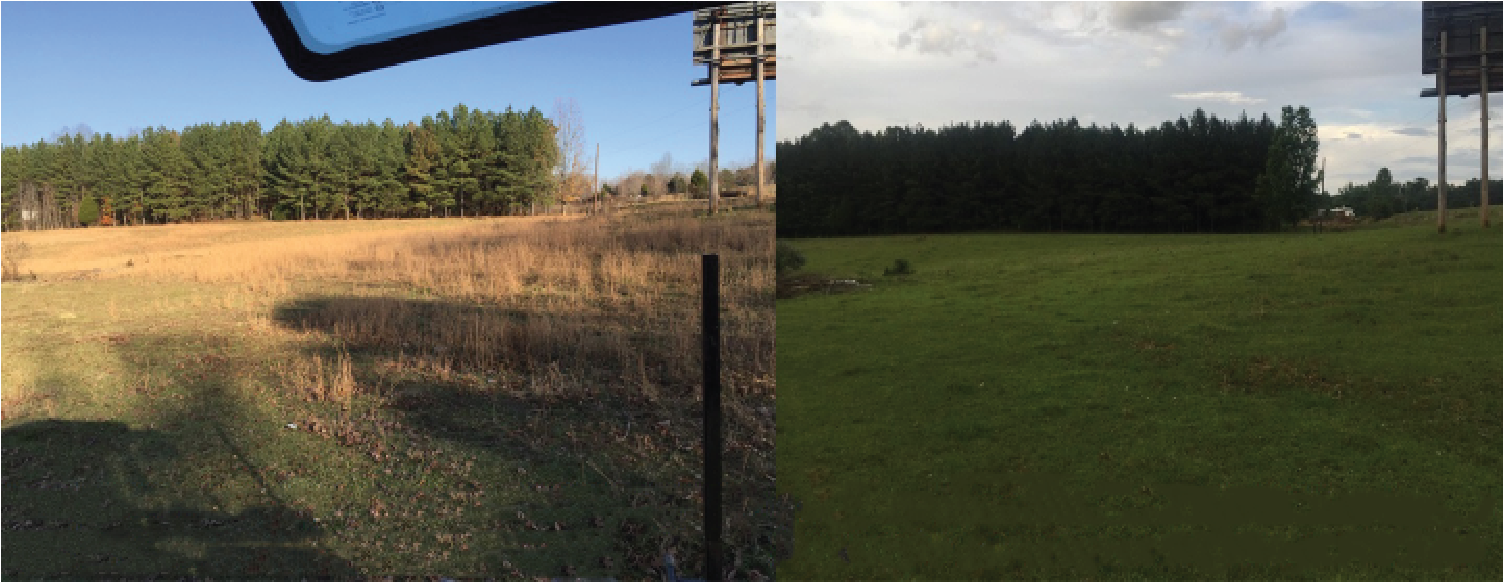
Left: Casey A. (NC) sent this picture in Dec 2017. Applied 4 gal Pro-Cal and ½ gal Gro, nothing else. Right: Casey sent this picture June 12, 2018. No broom sage; as you can see the grass is green. No fertilizer.
Casey A., NC
01 / Read the field
Broomsedge is a diagnosis, not an invader.
Broomsedge (Andropogon virginicus, the same plant your neighbors call sage grass or broom sage) doesn't outfight a healthy stand. It's a low-fertility specialist: it tolerates acidic, calcium-poor, phosphorus-poor ground that bermudagrass, fescue, orchardgrass, and clover can't perform on. When those forages thin out, broomsedge takes the bare ground they surrender.
That's why extension agronomists across the South treat broomsedge as an indicator plant. If it's spreading, you already know roughly what the soil test will say: pH below 6.0, hydrogen crowding the exchange sites, calcium base saturation short of where forage wants it.
And that's also the good news. A condition that soil chemistry created is a condition soil chemistry can reverse.
Watch
How you can get rid of sage grass.
What it's costing you in cattle performance, soil pH, and crop ground, and how correcting the soil underneath takes it out.
02 / The spray trap
You can't spray your way out of a soil condition.
No selective herbicide takes established broomsedge out of a grass pasture without setting back the forage around it. So the usual options all leave the cause untouched:
Spot-spraying
Takes out the clump, and leaves a bare, still-acidic patch that broomsedge seed is first to claim next spring.
Burning & clipping
Knocks back the top growth cattle won't eat anyway. The root system and the acidic ground underneath aren't going anywhere.
More nitrogen
On pH-5.0 ground most of that N never reaches the forage. Fertility poured onto acidic soil feeds the problem's economics, not the grass.
Herbicides have their place in a pasture program, and if you run one, keep it on a separate pass and never tank-mix Grazon or other picloram products with calcium. But against broomsedge specifically, spraying treats the symptom. The fix is under the sod.
03 / How it actually goes away
Fix the soil. Let the grass choke it out.
Liquid calcium doesn't attack broomsedge. It takes away the one thing broomsedge depends on: soil your forage can't compete on. Pro-Cal and Advanced-Cal begin correcting pH and calcium in weeks, not the seasons surface-applied dry lime needs on untilled ground. From there, the stand does the work.
Season 1
The ground shifts
pH climbs toward 6.0 and calcium base saturation rebuilds. Fertilizer that was locked up starts reaching the forage. Bermuda, fescue, and clover green up, thicken, and start filling bare ground.
Seasons 1–2
The competition flips
A denser stand shades broomsedge seedlings out and outdraws established clumps for water and nutrients. Growers report clumps fading and fewer new ones appearing.
Seasons 2–3
The stand takes it back
With nothing left that favors it, broomsedge gets crowded down to stray clumps and then none. What replaces it is grass you can cut, graze, and sell.
04 / The lab reports
The soil tests underneath the green-up.
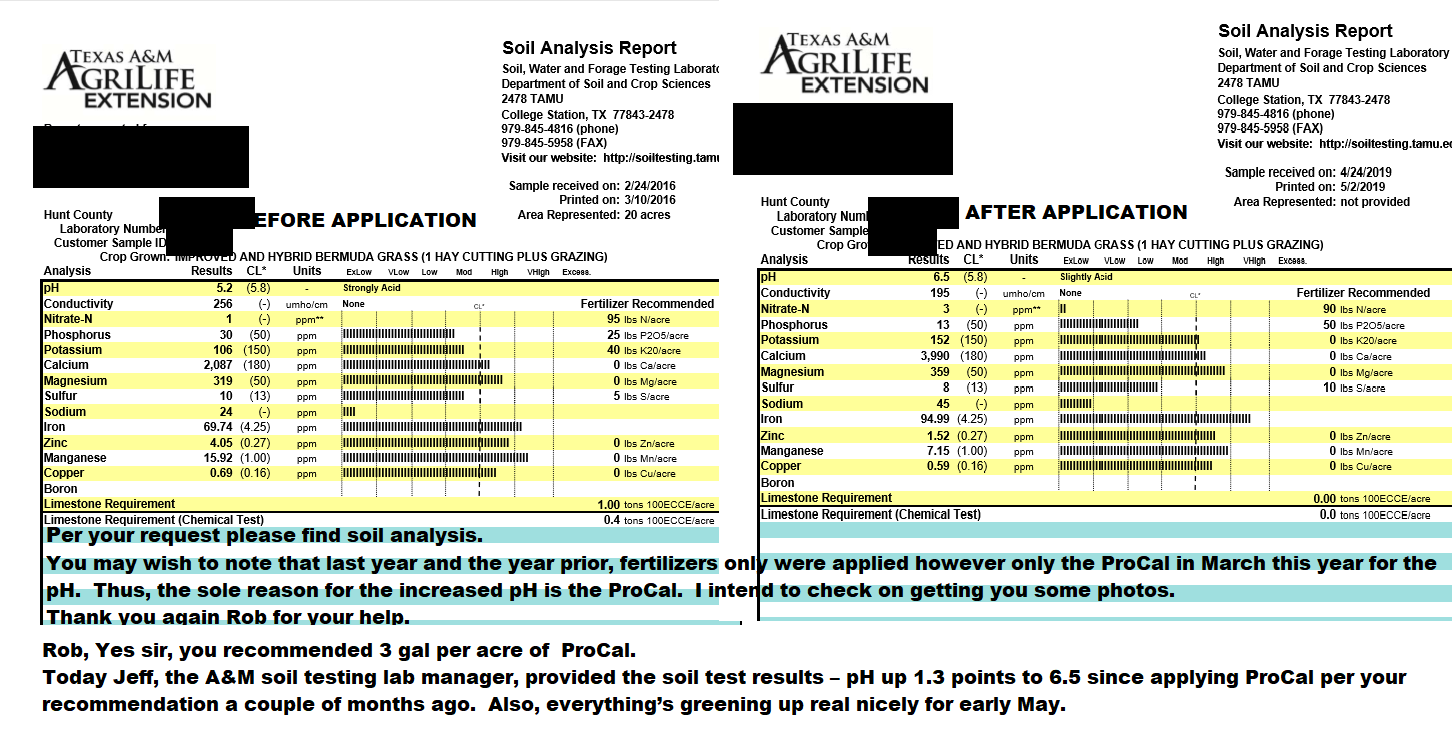
Broomsedge ground is low-pH ground. These are real hay and pasture lab reports (customer details redacted, dates kept) from growers who ran the calcium program. Click any pair to read the before and after side by side.
View full report → 


More before & after lab reports: see the full soil-test proof page
05 / Get the calcium
Order it right here. Sized from your soil test.
Advanced-Cal is liquid calcium plus micronutrients and biology, the version growers like Jonathan ran on ground broomsedge and thistle had overtaken. Punch your acres and the CEC and calcium base saturation off your soil test into the calculator at the top of this page. It sizes the containers, shows the delivered total with freight already in it, and sends the order to an agronomist to confirm before anything ships. No charge until it's confirmed.
Advanced-Cal
Calcium plus micronutrients and biology in one pass. It corrects the soil and feeds the stand that chokes the broomsedge out.
Full label, pricing & research →Pro-Cal
The straight-calcium foundation pass: same pH and calcium correction, without the added biology.
See Pro-Cal →Rather buy local?
119 dealers carry AgriTec calcium. Enter your ZIP and pick it up down the road.
Find your dealer →06 / On the record
17 growers. 11 states. Same story.
In their own words: read all grower stories
TX · 2025
"Worked pretty good, definitely helped get rid of the Broomsedge."
NC · 2024
"We came out around 20% more hay in each field we used procal on ,was a few weeks latter cutting dew to weather ,also no broom straw in spring cutting .which was very good .do you have any product that would help eliminate fox tail and jhonson grass thanks so much."
FL · 2022
"We put out the Adv Cal back in January because we had a broomsedge and pH problem. Now we have no broomsedge to mess with. We need some NitroMaxx+ now. We are very pleased with your products."
KY · 2022
"I applied your Pro Cal last year and it took care of all my broom sedge. I also got some of your nitromaxx plus and applied it 2 gallons per acre on half my fields. The other half I applied 100 lb of urea and did the same amount of bails. I'm going to up my application this year to 3 gallons of nitromaxx on everything."
MO · 2022
"Rob, I bought a tote of Procal and was very pleased, almost all the boomsage in my fields are almost gone. I am reorder to take care of the rest of the broomsage."
MS · 2022
"I got 5 more rolls per acre. I usually get 2 rolls per acre after the advanced cal I got 7. It just keeps getting better every time I use this stuff the grass is thicker and all my broom sedge is gone."
MO · 2021
"I can tell you it worked. The OMRI Calcium we used last year got rid of the broom sedge in most of our fields. They are looking really nice. We are going to try some Adv Cal that has the Bio-Act."
OH · 2021
"I purchased 75 gallons of pro-cal and had great results with it I had one field that was thick with the broom sage that's now a thing of the past I have been telling any and everyone how great my results were . Thanks"
OH · 2021
"We used your liquid calcium with fertilizer last year to get rid of the broom sage in our hayfields. It's still a little early to tell but so far so good. Hope it works as it should. Thanks for the free cap. I will definitely wear it as an advertisement for y'all. Thanks."
07 / Straight answers
Broomsedge questions we get every week.
What causes broomsedge in pastures and hay fields? +
Broomsedge (Andropogon virginicus, often called sage grass or broom sage) is an indicator plant. It moves in where soil pH has dropped, calcium is depleted, and fertility is low, conditions where bermudagrass, fescue, and clover can no longer compete. If broomsedge is spreading, your soil test will almost always show acidic, calcium-poor ground.
How do you get rid of broomsedge without herbicide? +
Fix the soil condition it depends on. Correcting pH and calcium with a liquid calcium program like Pro-Cal or Advanced-Cal restores the conditions your forage needs to compete. As the stand thickens back up, it chokes out the broomsedge. Growers typically report it fading over one to three seasons as the grass reclaims the ground.
Will spraying alone control broomsedge? +
There is no selective herbicide that removes established broomsedge from a grass pasture without setting back the forage around it, and spot-spraying leaves bare, still-acidic ground that broomsedge readily reseeds. Spraying treats the symptom. Until the pH and calcium underneath are corrected, the conditions that favor broomsedge over your forage are still there.
How long does it take for broomsedge to go away after correcting pH? +
Growers running Pro-Cal or Advanced-Cal typically see broomsedge start to fade the first season after application, with stands substantially cleaner in one to three seasons as the forage thickens and chokes it out. Liquid calcium begins moving pH in weeks rather than the 6–12 months surface-applied dry lime takes on untilled pasture.
Can I still run my herbicide program with liquid calcium? +
Yes, on separate passes. Most pasture herbicides are compatible with a calcium program, but never tank-mix Grazon (or other picloram-based products) with calcium. Jar-test any new mix and keep the calcium pass and the herbicide pass separate. Talk to an AgriTec agronomist about sequencing.
What rate of liquid calcium do I need for a broomsedge problem? +
Start with a soil test. Typical broomsedge ground tests pH 4.8–5.5 and runs Pro-Cal at 3–5 gal/ac as the foundation pass, but the right rate depends on your pH, calcium base saturation, and CEC. Send us your soil test and an agronomist will read every number and build the rate for your fields. No charge for the conversation.
Talk to an agronomist
Broomsedge told you what's wrong. Your soil test tells us the rate.
Send it in. A real agronomist reads every number, builds the calcium program for your fields, and tells you what the recovery will look like season by season. No call tree, no charge for the conversation.