

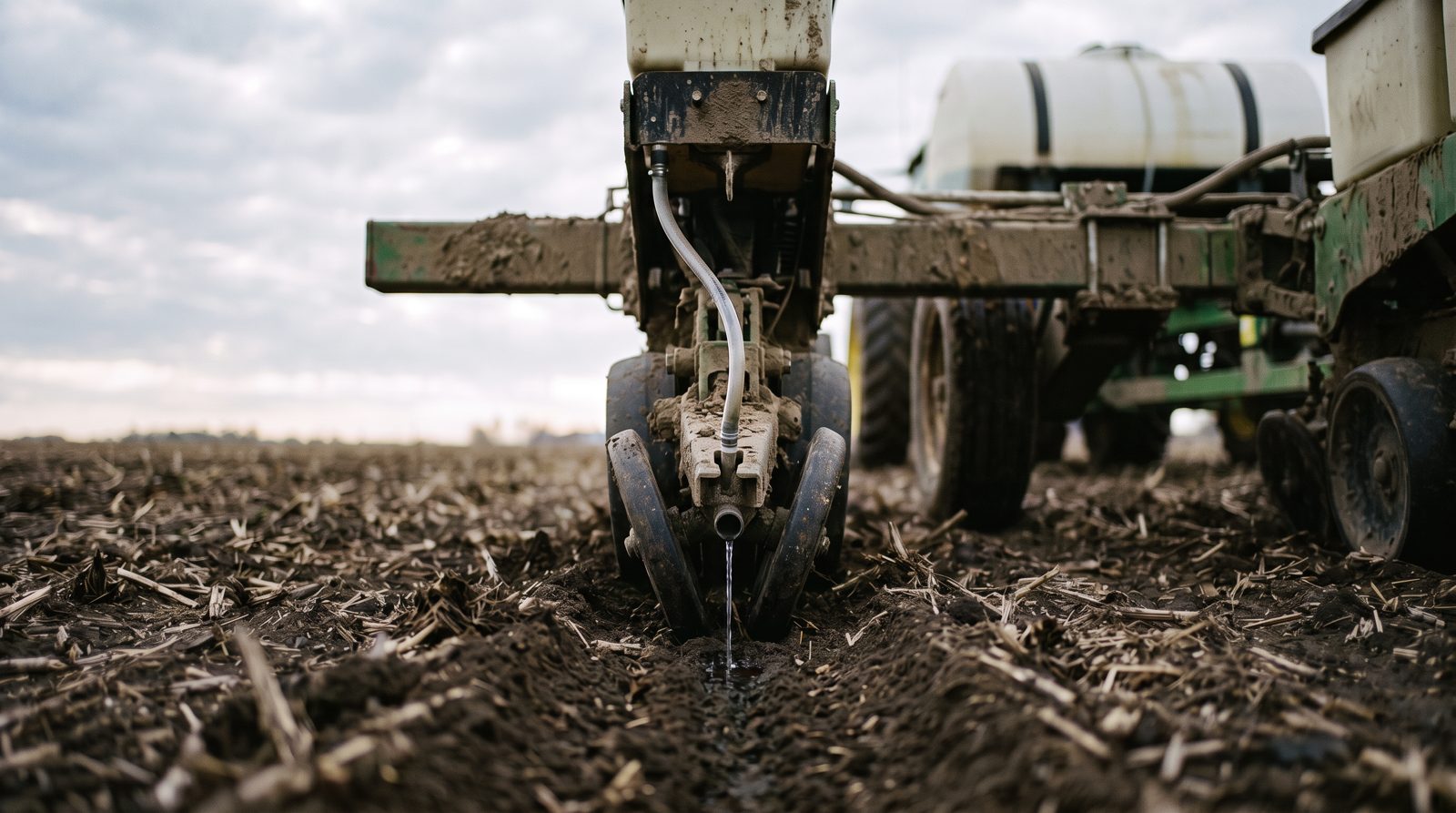
The best liquid starter fertilizer puts plant-available orthophosphate phosphorus and potassium right at the seed, in a low-salt liquid that goes in-furrow or in a 2x2 band at planting. It pays most in cold, early soils and on ground that tests low in phosphorus, because that is when a young root system cannot reach enough P on its own. AgriTec’s starter recommendation is 3-18-18+: orthophosphate P and K with a bio-activator package of micronutrients and kelp.
What is a liquid starter fertilizer?
A liquid starter fertilizer is a small dose of nutrients, mainly phosphorus and potassium, placed in or right beside the seed row at planting. It feeds the seedling before its roots can reach the fertility in the rest of the soil.
A seedling in its first few weeks has a root system measured in inches. Your broadcast P and K can be adequate on paper and still be out of reach in the window when the plant sets its early root architecture. A starter puts a concentrated, available supply exactly where the roots start, and a liquid rides along on the planting pass instead of adding a trip.
Why does starter pay in cold, early soils?
Because phosphorus barely moves in soil, and cold soil slows everything that could bring it to the root. Phosphorus is immobile, so roots have to physically reach it. Placing it in the row instead of broadcasting it reduces soil contact and fixation and improves how much of it the crop gets in the first season, which is what WSU Extension and the OSU Soil Fertility Handbook both describe.
Early planting stacks the odds against broadcast P. Roots grow slowly in cool, wet spring ground, and phosphorus moves toward them slowly too. A placed starter gets around that cold-spring lag because the phosphorus is already sitting where the first roots are. The flip side: on warm, late-planted ground that already tests high in phosphorus, the response shrinks.
Orthophosphate or polyphosphate: does the form matter?
Yes, for a starter it does. Orthophosphate is the form of phosphorus the plant takes up directly, without enzymatic conversion. Polyphosphate has to convert to orthophosphate in the soil before the crop can use it.
A starter’s only job is feeding the seedling in its first weeks, so a starter that waits on a conversion step shows up late.
3-18-18+ is 100 percent white-acid orthophosphate in a low-salt matrix. The phosphorus and potassium are available the moment the product goes down, with no conversion wait, which is the reason AgriTec builds its planting passes around it.
In-furrow or 2x2: where should the starter go?
Either works, and the right one depends on your planter and how much product you want to place. In-furrow puts the starter in the seed trench, in contact with the seed. A 2x2 band sits about 2 inches beside and 2 inches below the seed.
| In-furrow | 2x2 | |
|---|---|---|
| Where it goes | In the seed trench, touching the seed | About 2 inches beside and 2 inches below the seed |
| Equipment | Simple planter kit and tubes | Row-unit openers or coulters to cut the band |
| Seed contact | Yes, so salt and rate discipline matter | No, fertilizer stays off the seed |
AgriTec’s published Mid-South soybean program runs 3-18-18+ at planting “in-furrow or 2x2,” so the product is built for both. If you are starting from scratch, in-furrow is the cheaper way in. If you already run 2x2 openers, use them.
Is a liquid starter safe on the seed?
A low-salt orthophosphate liquid is designed to sit near the seed, which is what makes in-furrow placement possible at all. 3-18-18+ is built in a low-salt matrix for exactly that reason, and AgriTec’s in-furrow guidance is to keep salts low for emergence safety.
What we will not do is hand you a single maximum in-furrow rate here, because seed safety depends on the crop, the soil moisture at planting, soil texture, and what else is in the tank. Follow the product label and your agronomist for the in-furrow rate on your ground. If you want seed contact out of the equation entirely, a 2x2 band removes it.
How much liquid starter fertilizer per acre?
AgriTec’s published programs run 3-18-18+ at 4 to 7 gallons per acre depending on the crop and the tier. Those are program rates, not your rate.
| Crop | Timing and placement | 3-18-18+ rate | Source |
|---|---|---|---|
| Soybeans | At planting, in-furrow or 2x2 | 5 gal/ac (6 to 7 gal/ac in higher tiers) | AgriTec Mid-South soybean program |
| Corn | At planting, starter | 4 gal/ac | AgriTec corn program |
| Corn | Preplant, banded or streamed | 4 to 6 gal/ac by yield target | AgriTec Michigan corn P-K program |
| Cotton | At planting | 5 gal/ac | AgriTec Arkansas cotton program |
| Alfalfa | At establishment | 7 gal/ac | AgriTec alfalfa stand-longevity program |
The real rate comes from your soil test. Your phosphorus and potassium levels, pH, and yield goal decide where you sit in that range. The Michigan corn program, for example, sets rate by matching P and K pounds to crop removal at the target yield, then converting pounds to gallons.
Which crops respond to a starter?
Placed P and K serve every crop. The extra package in 3-18-18+ is where the crop choice starts to matter.
Soybeans and alfalfa are where 3-18-18+ is aimed. The bio-activator package carries zinc, manganese, boron, cobalt, and molybdenum plus Ascophyllum nodosum kelp extract. Cobalt and molybdenum are cofactors for biological nitrogen fixation, so on a legume they help the crop use nitrogen it is already fixing. Boron matters at flowering and pod set. See the soybean program for how the starter pass fits with the rest of the season.
Corn gets the orthophosphate P and K plus zinc and manganese, which run the enzyme systems behind early growth. Corn has no nodules, so the cobalt and molybdenum are not doing the same work there. AgriTec’s corn program runs 3-18-18+ at planting as the starter.
Cotton uses placed orthophosphate for early rooting and fruiting capacity; the Arkansas program puts it down at planting for early root and square set.
Where does 3-18-18+ fit in a full program?
It is the planting pass. It replaces the at-planting dry phosphorus and potassium by carrying P and K in orthophosphate form and placing it in the row instead of broadcasting it.
It does not replace pH or calcium correction. If the soil test shows low pH or short calcium base saturation, that still has to be fixed, which is why AgriTec’s published programs run a calcium pass underneath the starter rather than instead of it. One hard rule follows from that: Pro-Cal and Advanced-Cal must never share a tank with a phosphate product, and 3-18-18+ is a phosphate. Run calcium as its own pass, and jar test anything else before it goes in the planter tank.
What does the research say about starter yield response?
The broad evidence is solid where soil-test phosphorus is low. A meta-analysis by Quinn, Lee and Poffenbarger (Field Crops Research, 2020) found banded starter phosphorus raised corn yield 5.2 percent on average across 474 US comparisons, with 74 percent of trials responding. The response was strongest below critical soil-test P and faded on high-P soils. That study covers starter phosphorus in general, not 3-18-18+ specifically, so it is a planning assumption for low-testing ground, not a promise.
On AgriTec’s own products, the closest replicated data is the 2022 Agricenter International soybean trial in Memphis, Tennessee (randomized complete block, 4 reps). A three-pass calcium and 3-18-18 program made 70.8 bu/ac against 63.5 bu/ac for the untreated check, a gain of 7.3 bu/ac, in the top statistical group (P = 0.015, LSD 5.86 bu/ac). Stand counts were statistically identical, so the gain was not a population effect. The caveats matter: it was a single site in a single season, the treatment is printed in the report as “3-18-18,” and the result belongs to the whole program, not to the starter alone. Read the full trial report before you lean on it.
How do I decide if my field needs a starter?
Start with a soil test. Phosphorus and potassium tell you whether a starter fills a real gap, and pH tells you whether a calcium correction comes first. The earlier and colder you plant, the more a placed starter has to offer.
If you want a second set of eyes on it, send us a soil sample. AgriTec’s soil test review and agronomy consult are free to anyone who asks, whether or not you ever buy from us, and we will size the 3-18-18+ rate to your ground instead of to a published average.
Frequently asked questions
What is a liquid starter fertilizer?
A liquid starter fertilizer is a small dose of nutrients, mainly phosphorus and potassium, placed in or right beside the seed row at planting. It feeds the seedling before its roots can reach the fertility in the rest of the soil. AgriTec’s starter is 3-18-18+, an orthophosphate P and K liquid with a bio-activator package, placed in-furrow or 2x2.
Is orthophosphate better than polyphosphate for a starter?
Orthophosphate is the form of phosphorus the plant takes up directly, so it is available the day it goes down. Polyphosphate has to convert to orthophosphate in the soil before the crop can use it. For a starter, whose whole job is feeding the seedling in its first weeks, a 100 percent orthophosphate product like 3-18-18+ removes that wait.
Should I put starter fertilizer in-furrow or 2x2?
In-furrow puts the starter in the seed trench, in contact with the seed, and needs only a simple planter kit. A 2x2 band sits about 2 inches beside and 2 inches below the seed, which keeps fertilizer off the seed and allows more product. AgriTec’s published soybean program runs 3-18-18+ either way. Follow the product label and your agronomist on in-furrow rates.
How much liquid starter fertilizer do I use per acre?
AgriTec’s published programs run 3-18-18+ at 5 gallons per acre at planting on soybeans (6 to 7 gallons in the higher tiers), 4 gallons per acre as the corn starter, 5 gallons per acre at planting on cotton, and 7 gallons per acre at alfalfa establishment. Those are program rates, not your rate. A soil test sizes it to your phosphorus and potassium.
Does starter fertilizer actually increase yield?
Where soil-test phosphorus is low, usually yes. A meta-analysis by Quinn, Lee and Poffenbarger (Field Crops Research, 2020) found banded starter phosphorus raised corn yield 5.2 percent on average across 474 US comparisons, with 74 percent of trials responding. The response was strongest below critical soil-test P and faded on high-P soils. Treat it as a planning assumption, not a promise.
Can I tank-mix a liquid starter with liquid calcium?
No. Phosphate starters and liquid calcium products like Pro-Cal and Advanced-Cal must never share a tank. Run calcium as its own pass. For anything else you plan to mix with 3-18-18+, jar test first and check water quality, concentrations, and order of addition before you fill the planter tank.
Related reading
- AgriTec’s 3-18-18+ Is Cheaper and Better, for the case against dry DAP and potash.
- The Benefits of Pop-Up Fertilizer Programs for Corn and Beans, for more on in-furrow placement.
- What Is Liquid Calcium Fertilizer, and When Does It Pay?, for the calcium pass that runs underneath the starter.