

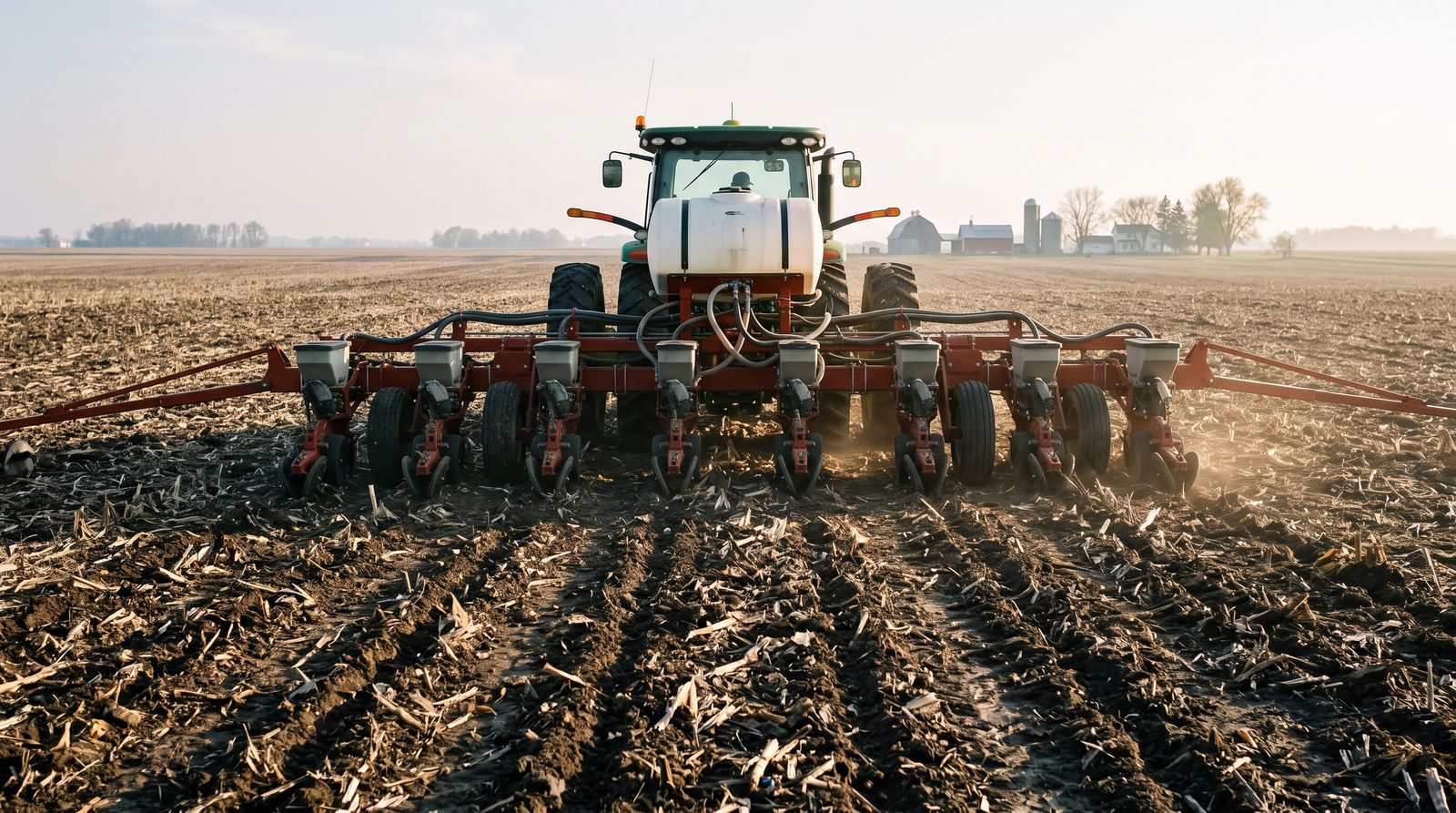
Starter fertilizer pays on corn most often where soil-test phosphorus is low, where corn is planted early into cold soil, and in no-till or continuous corn with heavy residue. Across 474 US comparisons it raised corn yield 5.2 percent on average and produced a gain in 74 percent of them, but the response shrinks on high-P ground, so treat it as a planning assumption, not a promise.
That is a better record than most inputs on a corn budget. It is also not a sure thing on every field, and the fields where it pays least are the ones with the highest soil tests. This guide covers when starter earns its place on corn, where to put it, how much is safe with the seed, and what it should carry.
Is starter fertilizer worth it on corn?
On most fields, more often than not. The best single answer comes from a 2020 meta-analysis by Daniel Quinn, Chad Lee and Hanna Poffenbarger (Field Crops Research), which pooled 474 US comparisons of corn with and without a banded starter. Starter raised grain yield 5.2 percent on average, and 74 percent of the comparisons showed a gain.
Several of their findings are useful when you are deciding for your own fields:
- It worked in both no-till and tilled ground, and after soybeans, corn, cotton, sorghum or wheat.
- Corn still responded when soil-test P and K were above critical levels, but the response got smaller as the tests climbed.
- The benefit grew at higher yield levels and shrank at higher seeding rates.
- N-P starters and N-P-K starters performed about the same. Phosphorus is the part doing most of the work.
Not every university reads its own trials that generously. Iowa State University Extension’s Antonio Mallarino points out that starter improves early growth far more consistently than it improves final yield, and University of Minnesota Extension’s Dan Kaiser and Jeff Vetsch caution that some of that early growth is cosmetic. Their practical advice: the answer comes down to whether your field needs the nutrients.
So, if you are planning around starter, use about 5 percent as a planning assumption on a field that fits the profile below, and expect less on ground that already tests high.
When does starter fertilizer pay on corn?
Iowa State University Extension lists the conditions where corn most reliably responds to starter:
- Early planting into cold soil. A small root system in cold soil cannot pull enough phosphorus on its own.
- No-till with heavy residue. Residue keeps the seedbed cooler and wetter in spring.
- Continuous corn, especially no-till.
- Ground that tests low in phosphorus or potassium, or where broadcast P and K have been cut below recommended rates.
- Late planting, mainly for the phosphorus response.
- Fields with no nitrogen applied before planting.
The more of those your field checks, the better the odds. A warm, conventionally tilled field with high soil-test P, planted in mid-May, is where starter is least likely to show up at the scale.
The quickest way to know which fields are which is a current soil test. AgriTec reviews soil tests free for any grower who asks, whether or not you buy anything from us. Send us a soil sample or a recent report.
Should corn starter go in-furrow or 2x2?
Both work when most of the crop’s nitrogen goes on at planting. The 2020 meta-analysis found in-furrow and 2x2 placement performed about the same in that case.
The difference shows up when most of the nitrogen goes on later. When the majority of N was sidedressed, only 2x2 placement increased yield, by 8.9 percent on average, and in-furrow starter showed no significant effect.
How the two compare in practice:
- In-furrow puts starter in the seed trench, in contact with the seed. It needs only a simple planter kit, but the rate is capped by what the seed can tolerate.
- 2x2 places a band about 2 inches to the side of and 2 inches below the seed. It needs more equipment, keeps fertilizer off the seed, and allows a higher rate.
If you sidedress most of your nitrogen and are buying equipment anyway, 2x2 has the stronger research case. If you already run an in-furrow kit and put most of your N on early, there is no research reason to switch.
Our liquid starter fertilizer guide covers placement in more detail across crops.
How much starter fertilizer is safe in-furrow with corn seed?
Keep salts low. Fertilizer salts sitting against the seed pull water away from it and can burn the radicle. Iowa State University Extension advises putting no more than 10 pounds of nitrogen plus potash (K2O) per acre in the seed furrow, with ammonium, potassium chloride, potassium nitrate and sulfur sources being the main concern.
Bayer’s agronomy team gives a product-level version of the same rule: no more than about 5 gallons per acre of 10-34-0 in-furrow on 30-inch rows in most conditions. They also list what makes injury more likely:
- Sandy or light-textured soil low in organic matter or clay.
- Dry soil at planting, which keeps salts concentrated near the seed instead of diffusing away.
Injured seedlings show short radicles with brown or black tips, roots that look burned off, and a stunted, spindly or wilted look.
On those higher-risk soils, move the starter to a 2x2 band. The 3-18-18+ label says the same: do not apply it directly on the seed in saline, alkali or coarse-textured soils. Follow the product label and your agronomist on in-furrow rates.
What should a corn starter fertilizer contain?
Phosphorus first. That is where most of the yield response comes from, and N-P and N-P-K starters performed about the same in the meta-analysis. Potassium earns its place on low-K ground and in continuous no-till corn.
The form of phosphorus matters too. Orthophosphate is the form the seedling takes up directly. Polyphosphate, the other part of a product like 10-34-0, has to convert to orthophosphate in the soil before the crop can use it. In cold spring soil, starter’s whole job is feeding a seedling in its first few weeks, so a product that is available on day one fits that job. University of Minnesota Extension adds a fair caution: compare products on cost per pound of nutrient, not on price per gallon or marketing.
Whatever the product, keep total N plus K2O in the furrow inside the limits above.
AgriTec’s corn starter is 3-18-18+: a 100 percent orthophosphate, low-salt liquid with equal P and K and a micronutrient and kelp package. Two handling notes: phosphate starters and liquid calcium products like Pro-Cal and Advanced-Cal must never share a tank, and anything else going in the planter tank should be jar-tested first.
How much 3-18-18+ does AgriTec use on corn?
AgriTec’s corn program places 3-18-18+ at 4 gallons per acre in the at-planting pass, with Carbon Core humic and Carbon Pulse in the same pass to feed root-zone biology. Higher program tiers add a foliar feed of 3-18-18+ at V5 to V8, at 2 to 4 gallons per acre, only where soil phosphorus is not already high, to carry phosphorus and potassium through ear development.
Those are program rates, not your rate. Soil-test P and K, soil texture, your placement and your nitrogen timing all move the number, which is why the program starts from a soil test. The corn nutrition plan guide shows where the starter fits in a full season, and the corn crop page has the full program.
Is starter fertilizer worth it on high-phosphorus soil?
Less often. The meta-analysis found corn still responded above critical soil-test P levels, but the gain got smaller as P climbed. On high-testing ground, starter is closer to a cold-soil insurance policy than a fertility program. University of Minnesota Extension’s suggestion is a good one: leave a few planter rows without starter and compare at harvest.
Frequently asked questions
Is starter fertilizer worth it on corn?
Often, but not everywhere. A meta-analysis of 474 US comparisons (Quinn, Lee and Poffenbarger, Field Crops Research, 2020) found starter raised corn yield 5.2 percent on average, with 74 percent of comparisons showing a gain. Iowa State University Extension reports the response is most reliable with early planting into cold soil, no-till with heavy residue, continuous corn, and ground that tests low in phosphorus. Treat it as a planning assumption, not a promise.
Should corn starter go in-furrow or 2x2?
Both work when most of the crop’s nitrogen goes on at planting. The same 2020 meta-analysis found that when most nitrogen was sidedressed, only 2x2 placement increased yield, by 8.9 percent, while in-furrow had no significant effect. In-furrow needs only a simple planter kit; 2x2 keeps fertilizer off the seed and allows a higher rate.
How much starter fertilizer can go in-furrow with corn seed?
Keep salts low. Iowa State University Extension advises no more than 10 pounds of nitrogen plus potash (K2O) per acre in the seed furrow, and Bayer’s agronomy guidance holds 10-34-0 to about 5 gallons per acre in-furrow on 30-inch rows. Sandy, low organic matter and dry soils are the riskiest. Where those apply, move the starter to a 2x2 band.
What should a corn starter fertilizer contain?
Phosphorus first. That is where most of the yield response comes from, and the 2020 meta-analysis found N-P and N-P-K starters performed about the same. Orthophosphate is the form the seedling takes up directly. AgriTec’s corn starter is 3-18-18+, a 100 percent orthophosphate, low-salt P and K liquid.
How much 3-18-18+ does AgriTec use on corn?
AgriTec’s corn program places 3-18-18+ at 4 gallons per acre in the at-planting pass, with Carbon Core humic and Carbon Pulse in the same pass. Higher program tiers add a foliar 3-18-18+ feed at V5 to V8, at 2 to 4 gallons per acre, only where soil phosphorus is not already high. A soil test sizes it to your ground.
Sources
- Daniel J. Quinn, Chad D. Lee and Hanna J. Poffenbarger, “Corn yield response to sub-surface banded starter fertilizer in the U.S.: A meta-analysis,” Field Crops Research 254:107834, 2020. Summarized in “Ten Lessons from Research about Corn Response to Starter Fertilization,” Purdue Agronomy Kernel News, September 2020.
- Antonio P. Mallarino, Iowa State University Extension and Outreach, “Starter Fertilization Sometimes Boosts Corn Yield,” Integrated Crop Management, March 2015.
- Dan Kaiser and Jeff Vetsch, University of Minnesota Extension, “Starter fertilizer for corn: 5 things to know,” Minnesota Crop News, April 2023.
- Bayer Crop Science, “What You Need to Know About In-Furrow Starter Fertilizer.”
- AgriTec 3-18-18+ product label.