
 View full report →
Fall liming program · Pro-Cal & Advanced-Cal
Lime this fall. See it work this fall.
Dry lime spread this fall is still breaking down at planting. Liquid calcium starts correcting pH and calcium base saturation in weeks, costs less per acre than a 2-ton lime pass, and binds into the soil instead of sitting on top of it all winter. Sized from your soil test, applied with the sprayer you already own.
Size it to your acres
How much Pro-Cal do you need?
Recommended rate: – gal/ac to reach 75% Ca base saturation
Enter your CEC and current Ca base saturation from your soil test, and we calculate the gal/ac to hit the 75% target, then size the order. Your agronomist confirms against your full test.
Enter your numbers and we'll pack the exact containers: delivered total, freight included. No surprises at the dock.
Your Ca base saturation is already at or above 75%.
You don't need a calcium application right now. Save it for the fields that do. Ask an agronomist what your soil actually calls for.
You'll need
–
We'd ship you
Delivered total
–
freight included · – / ac
–
Running tanker-scale volume? Bulk tanker loads are call-to-order: (833) 247-4832.
Pay in 4* 4 interest-free payments of – with PayPal Pay Later. Just – due today. John Deere Financial and AgQuest also available.
*Financing at checkout, subject to approval. Terms apply.
Your sized package
–
Pay in 4* Split it into 4 interest-free payments with PayPal · John Deere Financial · AgQuest · *terms apply
Paid securely at checkout: card or PayPal, including Pay in 4. Shipping is free on most orders, and a free soil or tissue kit comes with orders above $300. An AgriTec agronomist confirms quantities and delivery before anything ships. If anything needs adjusting, we refund the difference first. Prefer financing? Call (833) 247-4832.
The frame that matters
Liming isn't an input cost. It's the return on every other dollar.
$5.50 back per $1
Worked return in the University of Florida peanut trial: +866 lb/ac worth about $217 against about $39/ac of Advanced-Cal applied.
UF/IFAS study 113-24, 2024, per the report's own math
236 vs 176 bu corn
Same field, same fertilizer, split treatment: ag lime on one section, Pro-Cal on the other. The Pro-Cal section yielded 60 bushels more.
Bill H., MS grower report, 2019
Up to 71% unlocked
At pH 4.5, NRCS data shows 71% of applied fertilizer is chemically unavailable; 33% at pH 5.5. Correct the pH and the fertilizer you already buy starts reaching the crop.
USDA NRCS fertilizer-availability data
01 / The per-acre math
Cheaper than the lime truck, before you count the yield.
AgriTec's Nebraska wheat program replaces 1.5 to 2 tons of dry lime with 4 gal/ac of Pro-Cal, saving growers roughly $72/ac with the correction landing in-season. Here is that swap at today's delivered tote pricing:
One acre, this fall
Dry lime pass · 2 tons spread $110/ac
At $55/ton delivered and spread, a planning figure: local quotes swing widely. Working sometime next year.
Pro-Cal · 4 gal/ac (replaces 1.5–2 tons) $45.08/ac
At $11.27/gal delivered 275-gal tote pricing, applied with your own sprayer. Working in 7 to 14 days.
Kept in your pocket, per acre $64.92
And that's the smaller half of the return. The correction also unlocks the fertilizer acid ground was tying up, up to $33 of every $100 at pH 5.5.
| Your soil pH | Ca base sat. | Pro-Cal rate | ≈ $/ac at tote |
|---|---|---|---|
| 6.5–7.0 | 65–75% | 0.5 gal/ac | $6 |
| 6.0–6.4 | 59–64% | 2.0 gal/ac | $23 |
| 5.5–5.9 | 50–60% | 3.0 – 3.5 gal/ac | $34 – $39 |
| 5.0–5.4 | 40–50% | 3.5 – 4.5 gal/ac | $39 – $51 |
| 4.5–4.9 | 30–40% | 5.5 gal/ac | $62 |
The field rule of thumb before an agronomist tunes it to your CEC. Every rate on this page gets confirmed against your actual soil test before anything ships. Advanced-Cal runs the same rates at $13.09/gal tote with micros and biology included. Buying for next season instead? 2027 prebuy pricing is open through Nov 30.
02 / The fall window
Fall is the right time to lime. The question is what you lime with.
Soils acidify every season: crop removal, rainfall, and nitrogen fertilizer all push pH down. Correcting it in the fall is the classic move, because the soil gets months to stabilize before spring planting and the fields are clear of crops and traffic.
But the traditional tool for the job undercuts the timing. Dry ag lime takes 6 to 12 months to break down and start moving pH, so a fall spreading is really a bet on next fall. Meanwhile every month the ground sits acidic, the fertilizer already in your budget keeps getting tied up by soil chemistry instead of feeding the crop.
Liquid calcium keeps the fall timing and drops the wait. Pro-Cal and Advanced-Cal begin reacting within 7 to 14 days of application, which means the pH is corrected before winter, not sometime after next harvest.
03 / The problem with waiting
Two tons of lime. About 15 pounds of it works this year.
Of the roughly 600 lb of calcium in a 2-ton lime application, only about 15 lb becomes plant-available in a timely manner. The rest is still rock, dissolving on a multi-year clock. That single fact drives everything below:
The wait
6 to 12 months before pH starts to move, and 18 to 36 months to fully react. A fall spreading doesn't pay until the season after next. Liquid calcium reacts in 7 to 14 days, so a fall pass is corrected ground by spring.
The washing
Those months are spent as fine particles sitting on the surface, through every winter rain. On slopes and untilled ground, lime can move downhill and toward ditches before it ever reacts. Liquid calcium goes into solution and binds to the soil's exchange sites within days: it stays where you sprayed it.
The logistics
Bulk trucking, a spreader, and firm ground to carry them. Wet fall fields shrink the window fast. Pro-Cal and Advanced-Cal go on with the boom sprayer, pivot, or aerial pass you already run, on ground a lime truck can't cross.
| Fall liming, side by side | Dry ag lime (2 tons/ac) | Liquid calcium (soil-test rate) |
|---|---|---|
| pH response | 6–12 months to begin; 18–36 to fully react | Begins in 7–14 days; soil-test movement in weeks |
| Calcium available now | ≈15 lb of ≈600 lb applied | The soluble, reactive fraction, available on application |
| Where it goes | Sits on the surface until it dissolves; can wash on slopes | Into solution, bound to exchange sites within days |
| Application | Bulk trucking + spreader, needs firm ground | Your sprayer, pivot, planter, or aerial |
| No-till & pasture | Can't be incorporated; stays in the top inches for years | Moves into the profile in solution |
| Rate precision | Blanket tons per acre | Sized to each field's pH, CEC, and base saturation |
Reaction-time, solubility, and equivalence figures are from AgriTec's published lime-replacement programs and product documentation. One honest exception: if your soil test also shows magnesium below target, dolomitic lime remains a reasonable way to deliver Ca and Mg together. Send us the test and we'll tell you which you're looking at.
04 / The research
Replicated trials, not brochure claims.
Every figure below comes from a university or independent research-station trial you can read in full, statistics included, on our research pages.
Winter wheat · fall soil application · Agricenter International, Memphis TN
+9.5 bu/ac from Pro-Cal alone. +20.2 on the full program.
One soil pass in early November on pH 5.4 ground. Pro-Cal at 5 gal/ac yielded 88.1 bu/ac against 78.6 untreated; the full program hit 98.8. Significant at P = .0001 on a replicated 24-plot trial. Exactly the pass this page is about: fall applied, paid at the next harvest.
Read the full trial report →Peanut · liquid calcium vs spread material · University of Florida
3 gallons beat 1,250 pounds.
Advanced-Cal at 3 gal/ac out-yielded a full 1,250 lb/ac gypsum program in the same field: 6,300 vs 5,676 lb/ac, and +866 lb over the untreated check. The report works that out to $5.50 back per dollar spent at tote pricing.
Read the full trial report →+12% corn · +18% soybeans
Average yield response to correcting low pH across a global liming meta-analysis.
Li et al. 2019
+5 to +27 bu/ac soybeans
Response to liming pH 4.8 to 5.5 soils across 52 tests over 7 years.
Auburn University (Rogers 1973)
+0.78 pH avg (Pro-Cal)
Average soil-test movement across 13 paired independent-lab samples; Advanced-Cal averaged +0.57.
Nutrien/Waypoint, UGA & on-farm labs
05 / Before & after
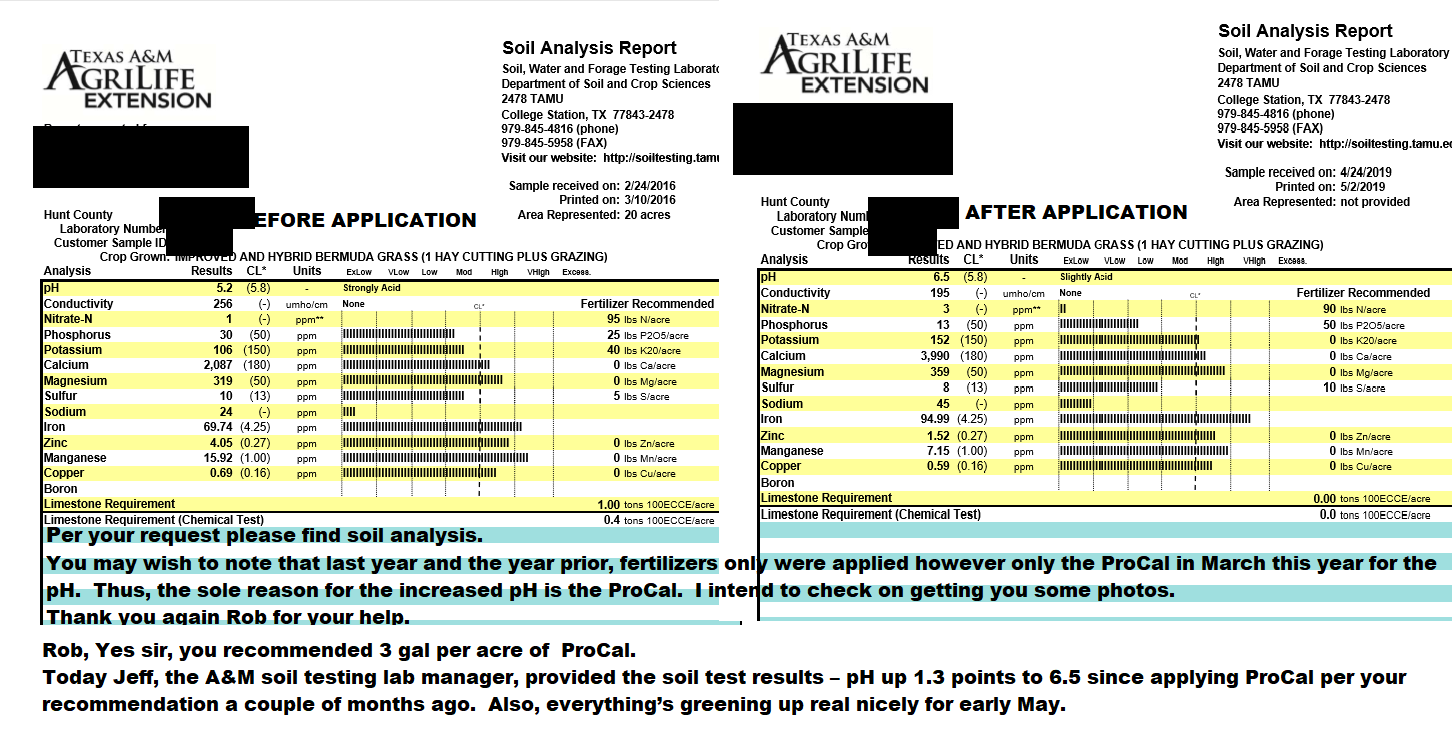
The soil tests before and after the pass.
Real grower lab reports, customer details redacted and dates kept. One of these moved pH 5.0 to 5.9 in about 70 days, well inside a single fall-to-spring window. Click any pair to read the before and after side by side.
View full report →  View full report →


Get the same movement on my fields →
More lab reports: see the full soil-test proof page
06 / The fields
Same field. One application apart.
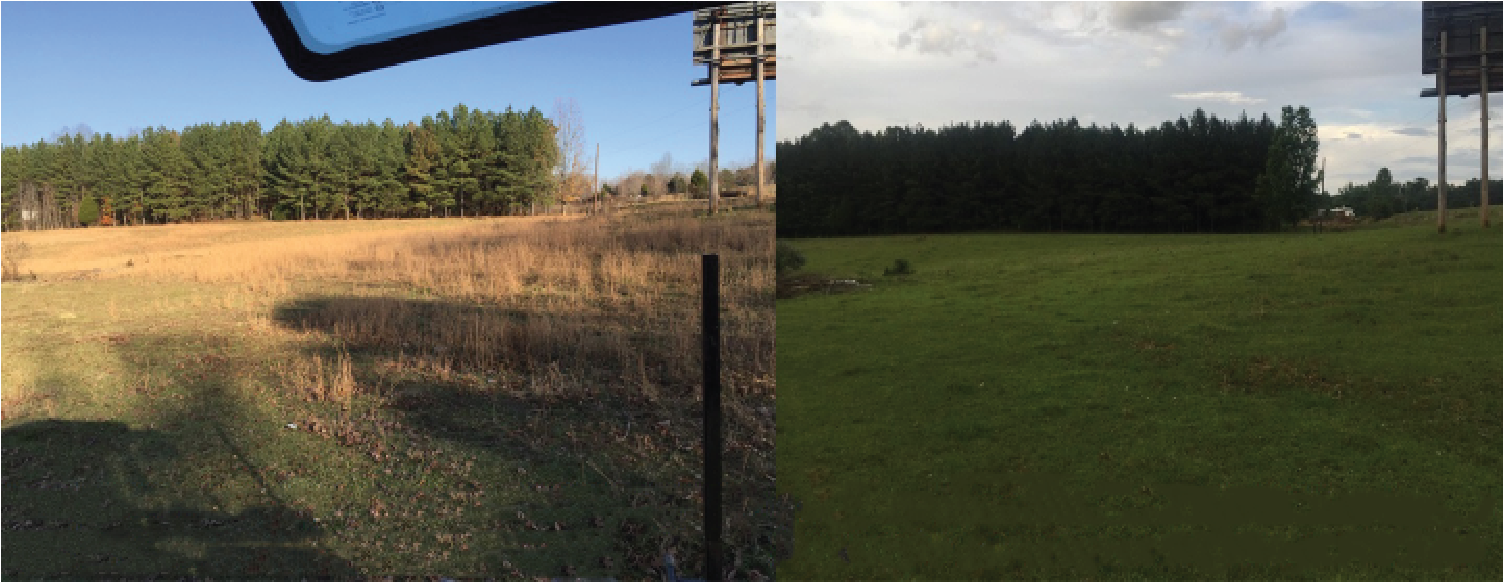
Left: Casey A. (NC) sent this picture in Dec 2017: applied 4 gal Pro-Cal and ½ gal Gro, nothing else. Right: Casey sent this picture June 12, 2018: no broom sage; as you can see the grass is green. No fertilizer.
Casey A., NC · winter application, next-summer result
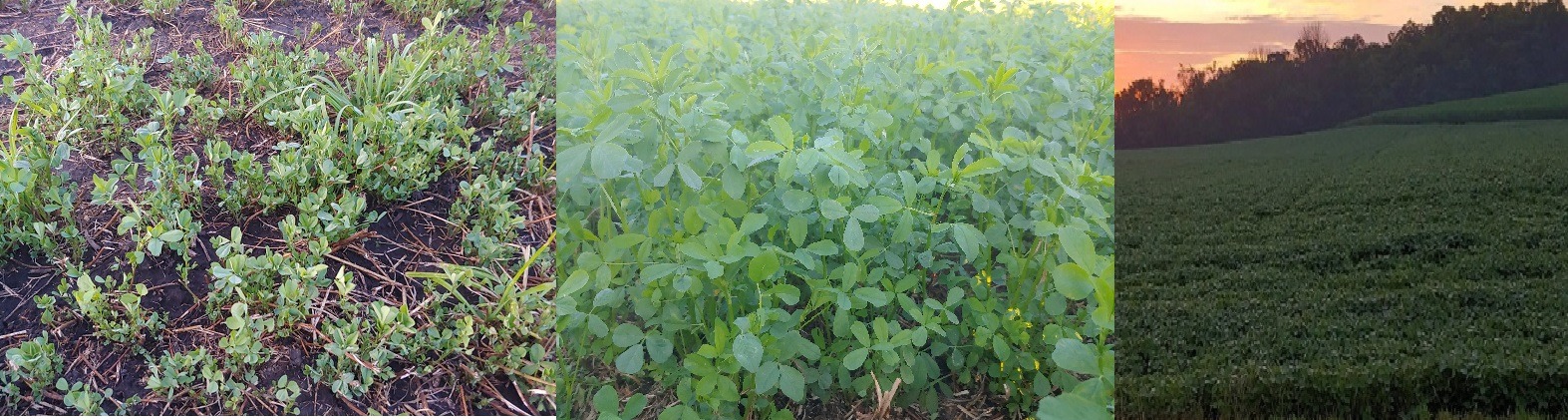
Before application · 3 weeks after applying 2.5 gal Advanced-Cal + 2 gal Nitro-Maxx+ · 8 weeks after application.
Grower-submitted, MN
More grower photos: browse the field gallery
07 / Get the calcium
Two ways to run the program. Both sized from your soil test.
Punch your acres and the CEC and calcium base saturation off your soil test into the calculator at the top of this page. It sizes the containers, shows the delivered total with freight already in it, and routes the order to an agronomist to confirm the rate before anything ships. No charge until it's confirmed.
The straight correction
Pro-Cal
Bio-activated liquid calcium
The fall liming workhorse: delivers the soluble portion of lime, raises pH and calcium base saturation in weeks, and replaces the 2-ton spread at a fraction of the per-acre cost. Rate: 0.5–5.5 gal/ac based on soil pH and base saturation.
5 gal jug $33.60/gal
55 gal drum $15.73/gal
275 gal tote $11.27/gal
4100 gal tanker $8.54/gal
The full rebuild
Advanced-Cal
Chelated liquid calcium + micros + microbes
The same calcium correction plus chelated boron, manganese, iron, and sulfur and a microbial package, in one pass. Built for long-cropped or depleted ground where the soil test shows more than pH out of range. This is the product that beat gypsum in the UF peanut trial. Rate: 0–5 gal/ac based on pH and base saturation.
5 gal jug $34.00/gal
55 gal drum $17.73/gal
275 gal tote $13.09/gal
4100 gal tanker $9.50/gal
Rather buy local?
AgriTec dealers across the country carry Pro-Cal and Advanced-Cal. Enter your ZIP and pick it up down the road.
Find your dealer →Have your soil test handy?
Run every number through the full program calculator and get a field-by-field plan, not just a calcium rate.
Run my soil test →08 / On the record
Growers who ran it against lime.
In their own words: read all grower stories
MS · 2019
"Pro cal boosted my yield on my corn up it came up wide open. I applied Ag lime and got 176 bushels per acre and then applied Pro Cal on a different section and got 236 bushels. Even the color was different between the two of them. Both areas had the same fertilizer and everything the only difference was the Pro Cal vs ag lime. I couldn't be more pleased im excited to use it again this year."
TX · 2024
"Last year bought the Pro-Cal from ya and used that and was pretty happy with it." The field weas calling for 2 tons of lime after the Pro-Cal application the soil sample is now only calling for .25 ton lime."
MS · 2022
"In May of 2021 I removed some of my cows (12 head on 20 acres) to another location so I could establish an Argentine Bahia hay field out of it. A soil sample showed it would need 2 tons of lime to the acre to get the ph level at an average. Instead I went with 3 gal to the acre of Pro Cal thinking it wouldn't be ready until 2022 cutting season. By June of 2021 I Started clipping the tops and see heads. By the end of July I ran another soil sample that showed my ph level was at an above average level and only required nitrogen and very little potash. I chose not to put anything extra on it and it continued to grow thicker and taller to the point I had to cut it and bale it. The results from the Pro Cal yielded 7 round bales (4x5) to the acre. This is a field that has had cows on it for the past 8 years."
OK · 2021
"We hadn't limed in years and we used the Pro-Cal and it doubled our hay yield"
OR · 2021
"I run a lawn company, and I tested some of your Adv Cal last year with one of my trucks. It worked great, the yards perked up nicely. My applicator absolutely loved how easy it was to handle in comparison to dry lime. This year we are going to switch our whole system to using Adv Cal and Humic Acid. It works great with our program."
09 / Straight answers
Fall liming questions we get every week.
When should I apply liquid calcium in the fall? +
Any time after harvest and before the ground freezes. Because Pro-Cal and Advanced-Cal begin reacting within 7 to 14 days instead of the 6 to 12 months dry lime needs to break down, the window is wide: even a late-fall pass has the pH corrected before spring planting, not the following fall.
How much Pro-Cal or Advanced-Cal do I need per acre? +
It comes off your soil test, not a blanket number. Typical rates run 0.5 gal/ac for maintenance up to 5.5 gal/ac on severely acidic ground (pH 4.5 to 4.9), sized from your pH, CEC, and calcium base saturation. Send us your soil test and an agronomist will build the exact rate for each field at no charge.
How does a gallon of liquid calcium compare to a ton of ag lime? +
AgriTec's Nebraska wheat lime-replacement program runs Pro-Cal at 4 gal/ac in place of 1.5 to 2 tons of dry lime. The reason so few gallons can do that work: of the roughly 600 lb of calcium in a 2-ton lime application, only about 15 lb becomes plant-available in a timely manner. Pro-Cal delivers the soluble, reactive fraction of lime, the part that actually moves your soil test.
Does liquid calcium wash away over the winter? +
It goes into the soil solution and binds to the exchange sites within days of application, so it is in the soil rather than sitting on it. Surface-spread dry lime spends months as fine particles on top of the ground waiting to dissolve, exposed all winter to rain moving it off slopes and toward low spots before it has reacted.
Can I apply it on no-till fields or established pasture? +
Yes. That is where liquid calcium fits best, because dry lime can't be mechanically incorporated on those acres and surface-applied lime stays in the top few inches for years. Pro-Cal and Advanced-Cal go on with a boom sprayer, pivot, or aerial application and move into the profile in solution.
How long does a fall application last? +
Broadcast applications typically carry a 3 to 4 year residual, the same maintenance cycle growers run with high-quality lime. We recommend re-testing the soil 9 to 12 months after application so you can see the movement on paper and plan the next pass from data.
Should I use Pro-Cal or Advanced-Cal? +
Pro-Cal is the straight correction: liquid calcium that raises pH and calcium base saturation. Advanced-Cal is the same correction plus chelated micronutrients (boron, manganese, iron, sulfur) and a microbial package, built for fields that need more than pH fixed. If the soil test shows micro deficits or the field has been worked hard for years, Advanced-Cal earns its premium; otherwise Pro-Cal does the job.
Talk to an agronomist
The fall window is open. Your soil test sets the rate.
Send it in. A real agronomist reads every number, builds the fall liming program for your fields, and shows you the math on what the correction returns. No call tree, no charge for the conversation.