

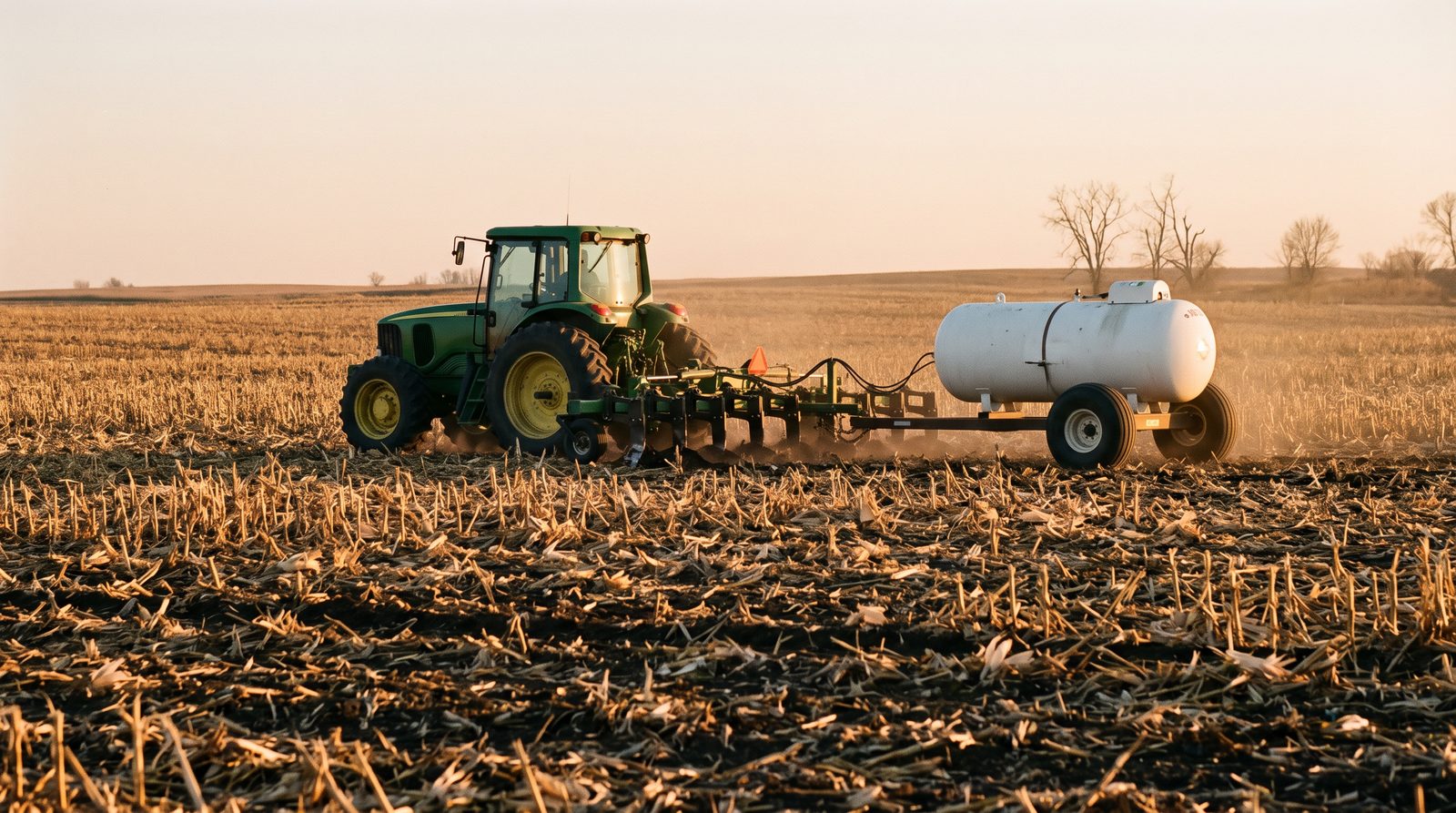
Anhydrous ammonia is the most concentrated nitrogen fertilizer farmers can buy, 82 percent nitrogen, stored as a liquid under pressure and injected into the soil as a gas. In the injection band it briefly pushes pH above 9 and harms soil microbes and roots for up to several weeks, and over the long run the nitrogen it supplies acidifies the soil.
None of that makes anhydrous a bad fertilizer. It is cheap, it works, and it feeds a lot of the corn grown in this country. It does mean the ground under a long-term anhydrous program needs watching, mostly for one thing: pH.
What is anhydrous ammonia fertilizer?
Anhydrous ammonia is ammonia gas (NH3) with no water in it, which is what “anhydrous” means. At 82 percent nitrogen, a pound of it carries more than twice the nitrogen of a pound of a 32 percent UAN solution.
It is kept as a liquid in pressurized nurse tanks. When it leaves the tank it turns to gas, so it has to go into the ground, not on top of it. Iowa State University Extension’s guidance is to inject it 6 to 8 inches deep with knives or coulters and get a good seal over the injection track, so the gas stays in the soil long enough to react.
Once it is in the soil, ammonia grabs water and becomes ammonium (NH4+). Ammonium has a positive charge, so it holds onto clay and organic matter instead of washing out. That is why anhydrous is a stable way to store nitrogen in the field until soil bacteria convert it to nitrate, the form that moves with water.
Because it is a hazardous gas under pressure, anhydrous also needs proper equipment, protective gear and handling. That cost and that risk are part of the decision, not just the price per pound of N.
What is anhydrous ammonia used for in farming?
It supplies nitrogen, mainly for corn and other grass crops such as wheat and sorghum, which need far more nitrogen than legumes. Farmers choose it because it is usually the cheapest nitrogen per pound and one pass can put down most of a corn crop’s nitrogen.
There are three common timings:
- Fall, after harvest. Spreads the workload and locks in a price. It only works when the soil is cold enough to hold the nitrogen as ammonium over winter (more on that below).
- Spring, before planting. Closer to when the crop needs it, so less time for losses.
- Sidedress. Injected between rows after the crop is up, closest to the crop’s peak demand.
What does anhydrous ammonia do to the soil?
It does three things, and they happen on different clocks.
What happens in the injection band in the first few weeks?
The band gets harsh for a while. Iowa State University Extension (John Sawyer) describes the ammonia retention zone as up to 3 to 4 inches in radius around each injection point, with most of the ammonium within the first inch or two. In that zone, the reaction of ammonia with water drives pH up, and it can temporarily rise above 9 at the point of highest concentration.
Free ammonia at that concentration damages microorganisms and plant roots. Iowa State describes the center of the band as partially and temporarily sterilized, and those conditions can last as long as several weeks. Bacteria recover from the outer edges of the band inward as the ammonia converts and the soil settles.
The fair way to read this: it is a real effect, it is local to the band, and it is temporary. It is not the whole field going sterile every year. The practical risk is roots and seedlings, which is why deep injection and a good seal matter, and why spring anhydrous is kept away from where the seed row will go.
Does anhydrous ammonia make soil acidic?
Over time, yes. The band starts out alkaline, but soil bacteria then convert ammonium to nitrate, and that conversion (nitrification) releases acidity. Iowa State notes that nitrification ultimately brings the band’s pH back to where it started or lower.
This is not unique to anhydrous. Every ammonium-based nitrogen source, including urea and UAN, acidifies soil as it nitrifies. Anhydrous just tends to be the source on fields that get the most nitrogen, year after year. On ground with a long corn history and no liming plan, a slowly falling pH is the normal result.
That matters because pH controls how much of everything else you apply can actually reach the crop. USDA NRCS nutrient availability data puts roughly 33 percent of applied fertilizer chemically unavailable at pH 5.5, and about 20 percent at pH 6.0. Our soil pH guide walks through why.
What happens to nitrogen if the soil is too warm or too dry?
It gets lost. Once ammonium converts to nitrate, it can leach with heavy rain or be lost as gas from waterlogged soil. Warm soil speeds that conversion, which is why fall timing matters so much.
Soil condition at application matters too. Iowa State has written about anhydrous in dry soil: in dry or cloddy ground the injection slot does not seal well, and ammonia can escape back to the air before it reacts.
When can you apply anhydrous ammonia in the fall?
Wait until the soil at 4 inches stays below 50 degrees F and is trending colder. That is the guidance from Iowa State University Extension and USDA NRCS, and it exists because the bacteria that turn ammonium into nitrate slow down sharply in cold soil.
Apply too early and the nitrogen spends weeks of mild fall weather converting to nitrate, which is exposed to leaching and denitrification all winter and spring. Iowa State also recommends considering a nitrification inhibitor with fall anhydrous to slow the conversion further.
Many state extension services publish daily soil temperature maps through October and November. Check yours before the toolbar goes in the ground.
How do you protect your soil on an anhydrous program?
You do not have to give up anhydrous to keep the ground healthy. You have to measure what it is doing and correct what you find.
Test pH every two to three years
A soil test is the only way to know whether nitrogen-driven acidity is catching up with you. Look at pH, calcium base saturation and CEC together. A field that has slipped from 6.5 to 5.8 over a decade of corn does not look different from the road, but it is quietly locking up fertilizer.
AgriTec reviews soil tests free for any grower who asks, whether or not you buy anything from us. Send us a soil sample or a recent report.
Correct acidity before it costs you
When the test shows low pH or low calcium, correct it. Dry ag lime works, but it is rock that has to dissolve, so it can take a year or more to fully react.
Pro-Cal is AgriTec’s liquid calcium for that job. It raises pH and calcium base saturation in weeks, goes on through a sprayer at gallons per acre, and fits around a nitrogen program instead of waiting on it. As a starting reference from AgriTec’s rate guide, ground at pH 6.0 to 6.4 runs about 2 gallons per acre and pH 5.5 to 5.9 runs 3 to 3.5 gallons, tuned to your CEC and base saturation. The liquid calcium fertilizer guide covers how it works and when it pays, and How to Raise Soil pH Without Lime works through the rates.
Support the soil biology
Healthy biology is what turns residue and organic matter into available nutrients, and it is what recolonizes the injection band. Organic matter, residue and balanced micronutrients all support it. Bio-Act, AgriTec’s micronutrient and humic acid blend (B, Co, Mn, Zn and Mo with humic acid), goes on as a soil treatment, seed starter or foliar feed as part of that program.
Split some of the nitrogen in season
Putting all of a crop’s nitrogen down months before it needs it is where losses come from. Many growers keep anhydrous as the base and split the rest in season, closer to peak demand. Nitro-Maxx+ is AgriTec’s slow-release liquid nitrogen (20 percent N) for those in-season passes, applied through a sprayer with no knives or pressurized tanks.
Is anhydrous ammonia bad for the soil?
Not on its own. The band effect is real but short and local, and the acidity it leaves behind is the same acidity any ammonium nitrogen leaves. The damage comes from running a heavy nitrogen program for years without testing and correcting pH. Do that part, and anhydrous can stay a low-cost nitrogen source without slowly costing you the soil it goes into.
Frequently asked questions
What is anhydrous ammonia fertilizer?
Anhydrous ammonia (NH3) is a nitrogen fertilizer that is 82 percent nitrogen, the most concentrated source available. It is stored as a liquid under pressure and becomes a gas when released, so it is injected 6 to 8 inches below the surface with knives or coulters and sealed in, where it reacts with soil water to become ammonium.
What is anhydrous ammonia used for in farming?
It supplies nitrogen, mainly for corn and other grass crops such as wheat and sorghum. Farmers use it because it is the cheapest nitrogen per pound in most years. It goes on before planting, in fall after soils cool or in spring, and sometimes as a sidedress between rows.
Does anhydrous ammonia hurt soil microbes?
Inside the injection band, yes, for a while. Iowa State University Extension reports pH can briefly rise above 9 at the point of highest concentration, and free ammonia damages microorganisms and roots. The center of the band can stay partially sterilized for several weeks before bacteria recover from the edges inward. The effect is local to a zone about 3 to 4 inches around each injection point, not the whole field.
Does anhydrous ammonia make soil acidic?
Over time, yes. The band starts out alkaline, but as soil bacteria convert ammonium to nitrate, that process releases acidity and takes pH back to where it started or lower, according to Iowa State University Extension. Every ammonium-based nitrogen source does this, so years of nitrogen without a liming plan pull pH down. A soil test every two to three years shows whether it is happening on your ground.
When can you apply anhydrous ammonia in the fall?
Iowa State University Extension and USDA NRCS advise waiting until soil temperature at 4 inches stays below 50 degrees F and is trending lower. Warmer soil converts ammonium to nitrate faster, and nitrate can leach or be lost before the crop is planted. A nitrification inhibitor slows that conversion further.
What can I do about the soil acidity nitrogen leaves behind?
Test, then correct what the test shows. AgriTec’s Pro-Cal is a liquid calcium that raises pH and calcium base saturation in weeks rather than the year or more dry lime takes. AgriTec’s rate guide starts around 2 gallons per acre at pH 6.0 to 6.4 and 3 to 3.5 gallons at pH 5.5 to 5.9, tuned to your CEC and base saturation.
Sources
- John Sawyer, Iowa State University Extension and Outreach, “Understanding anhydrous ammonia application in soil,” Integrated Crop Management, March 2019.
- John Sawyer, Iowa State University Extension and Outreach, “Anhydrous ammonia application, spring 2019” and “Anhydrous ammonia application in dry soil.”
- Iowa State University Extension and Outreach with the Iowa Department of Agriculture and Land Stewardship, “Wait for soil temps to remain below 50 degrees to apply anhydrous ammonia.”
- USDA NRCS, nutrient availability by soil pH.