

Free agronomy on every program · John Deere Financial & AgQuest financing available

Case study · Soybeans

Beans fix their own nitrogen, so the yield is set by nodes, pods, and fill. Balance the calcium foundation, place orthophosphate P-K at planting, and defend the pods with boron.

  • Region Mid-South soybean acres · Alcorn State / Agricenter trial ground
  • Scope Row-crop beans · average soil, calcium-first read
  • Outcome Alcorn State trial · 42 bu/ac control → 62 bu/ac full program (+48%) on average soil

The numbers behind it

The soybeans trial that proves it works.

Alcorn State University · AgriCenter · 2022. Partnership trials with Alcorn State and Agricenter Memphis. Full chart and methodology in Research booklet 2025.

Every plot in the trial · bu/ac

Control

42

Pro-Cal + 3-18-18+

55

Full program + BoroLift

62

YIELD LIFT

+0%

vs control plot

BEST PLOT

0 bu/ac

Full program + BoroLift

TREATMENTS

0

all outperformed control

CONTROL

0 bu/ac

Control

Full AgriTec soybean program documented at 60–65 bu/ac on average soil.

01

The local challenge

Soybeans are nitrogen-fixing, so growers under-invest in fertility and let the crop coast. But beans set yield at the nodes, and nodes form better on calcium-saturated, well-buffered soil. When Ca base saturation runs low, you lose node count before the plant ever flowers.

The other two leaks are phosphorus placement and boron. P drives nodulation and pod count, but broadcast dry P is slow to reach the seedling root. And below about 0.5 ppm tissue boron, beans abort pods right at the node during flowering, a loss you never see until the combine.
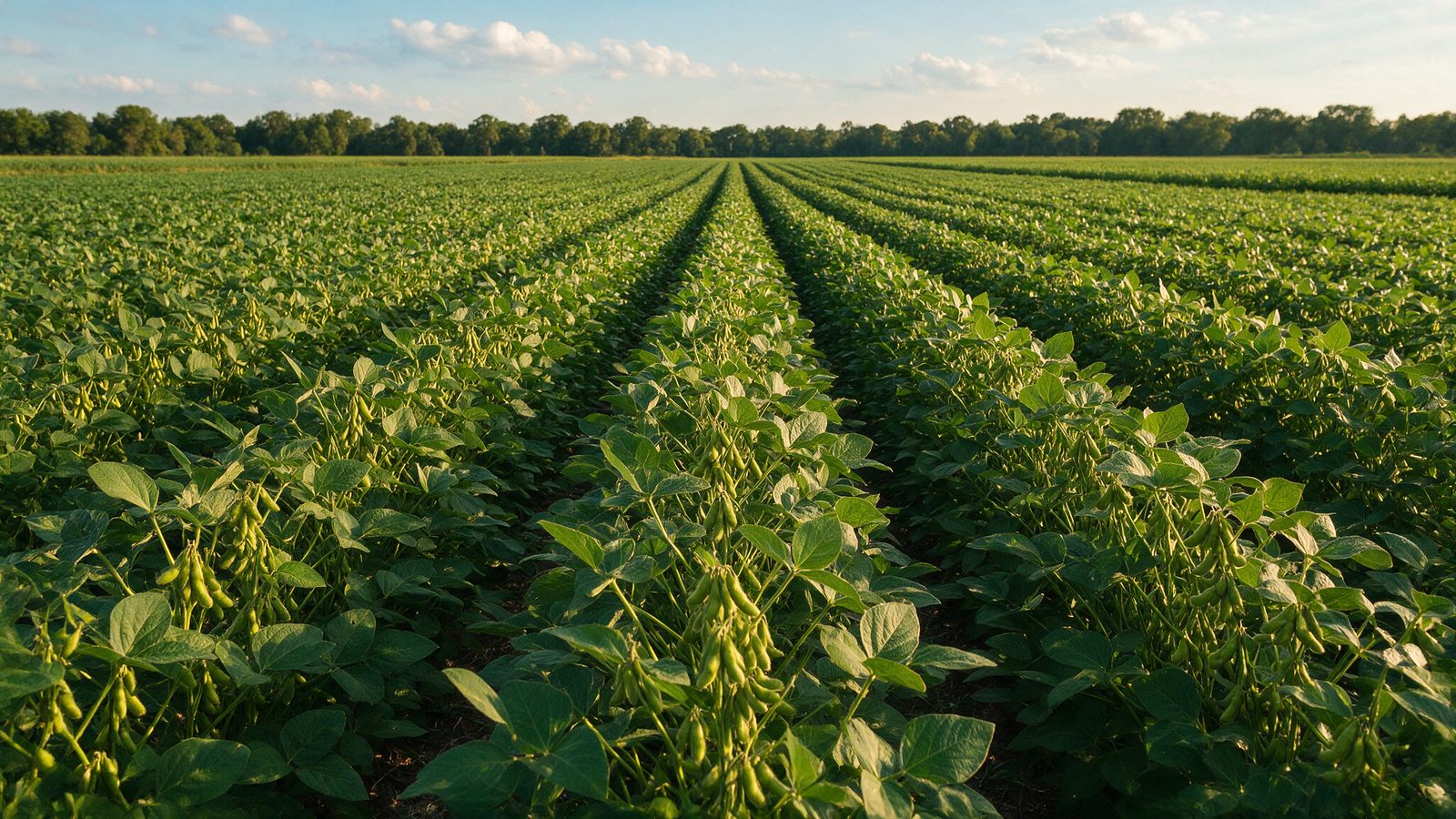
Dense mid-South soybean canopy in late summer

02

What Alcorn State documented

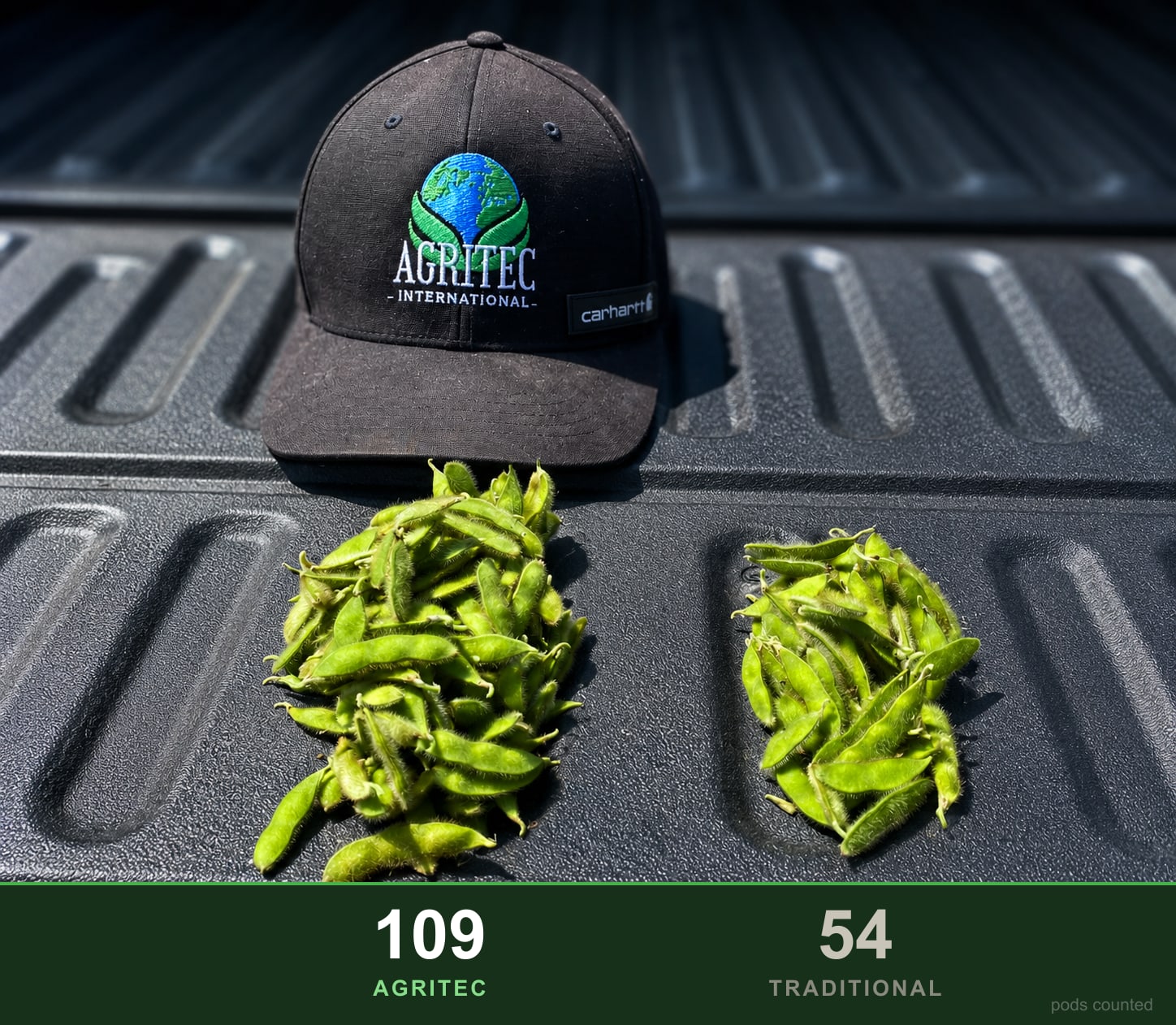
AgriTec's partnership trials with Alcorn State University and Agricenter Memphis ran the full soybean program against an untreated control on average soil. The control made 42 bu/ac. Pro-Cal plus 3-18-18+ lifted it to 55. Adding BoroLift for pod fill carried it to 62 bu/ac, a +48% lift, replicated and university-partnered.

That mirrors what growers report on their own ground. One Pennsylvania grower: "In the last several years since using Pro-Cal we've averaged 60–70 bu an acre, a 20 bu increase over what we used to produce." An Iowa grower ran Advanced-Cal at 2.75 gal/ac and called it "the best beans stand I've ever grown, 95 bushel per acre."

Soybeans field

03

Why these liquid forms specifically

3-18-18+ is built for legumes: 100% orthophosphate P and K that's immediately available, in a low-salt matrix with a built-in bio-activator, placed at the seed zone where broadcast dry can't reach on day one. Pro-Cal raises Ca base saturation in weeks, not the 12–18 months dry lime takes to move the numbers.

BoroLift delivers roughly 3× the tissue availability of standard boron and goes on foliar at first flower, exactly when pod set is decided. YieldMaker through the mid-vegetative window keeps photosynthesis and micro nutrition peaked into R-stages.

The program · three tiers

Good · Better · Best.

GOOD

Foundation + placement: the two biggest leaks

  • Pre-plant · broadcast

    Pro-Cal

    2–3 gal/ac

    Sets pH + Ca base saturation for node set

  • At planting · in-furrow or 2×2

    3-18-18+

    5 gal/ac

    Ortho P-K for nodulation + pod count

Outcome

Fixes the calcium foundation and puts available P-K on the seed, the jump from 42 to 55 bu/ac in the trial.

BETTER

Add pod-fill boron · RECOMMENDED

  • Pre-plant · broadcast

    Pro-Cal

    3 gal/ac

  • At planting

    3-18-18+

    6 gal/ac

  • First flower · R1–R2 foliar

    BoroLift

    1 gal/ac

    Defends pod set at the node

Outcome

The tier that reached 62 bu/ac in the trial. Boron at flower is the cheapest yield insurance beans have.

BEST

Full season · foundation to finish

  • Pre-plant · broadcast

    Pro-Cal

    3–5 gal/ac

  • At planting

    3-18-18+

    6–7 gal/ac

  • V4–V6 · foliar

    YieldMaker

    1 qt/ac

    Kelp + micro boost

  • First flower · R1–R2

    BoroLift

    1 gal/ac

  • R3–R5 · optional foliar

    YieldMaker

    1 qt/ac

    Holds fill through pod set

Outcome

Maximum node set, pod count, and fill. Best fit for high-yield-environment beans chasing the ceiling.

Logistics · Free shipping on tote orders. Carrier: 10–20 GPA, flat-fan nozzles. We'll build the per-acre ROI around your bean price and yield-environment before you commit a single acre.

The process

From your soil test to your program. Five days, max.

No back-and-forth, no upsell calls, no rate cards. Send the lab report, get a custom program. Free.

  1. 01 Same day

    You send your soil test

    Snap a photo of the lab PDF, upload a CSV, or email the file. We accept anything: Midwest Labs, A&L, Waters, Servi-Tech, you name it.

  2. 02 Day 1–2

    An agronomist reads it

    Not a sales rep. A real agronomist trained on the soil science. They look at every column: pH, base saturation, micros, organic matter.

  3. 03 Day 3–5

    We write your program

    Field-by-field plays with product, rate, timing, and the rationale behind each call. Multi-tier (good/better/best) so you choose the spend.

  4. 04 When it lands

    You get the document

    Same kind of multi-page program you just flipped through: branded, redaction-free, priced to today's market. No charge. No catch.

We built that one for free.

Want one for your fields?

Send us your soil test. An AgriTec agronomist will write the same kind of program for your acres. No charge, no call tree, priced to today's market.

Help us tailor the site

What do you grow?

1 / 2

Pick any that apply. The more we know, the better the recommendations.

Pick at least one